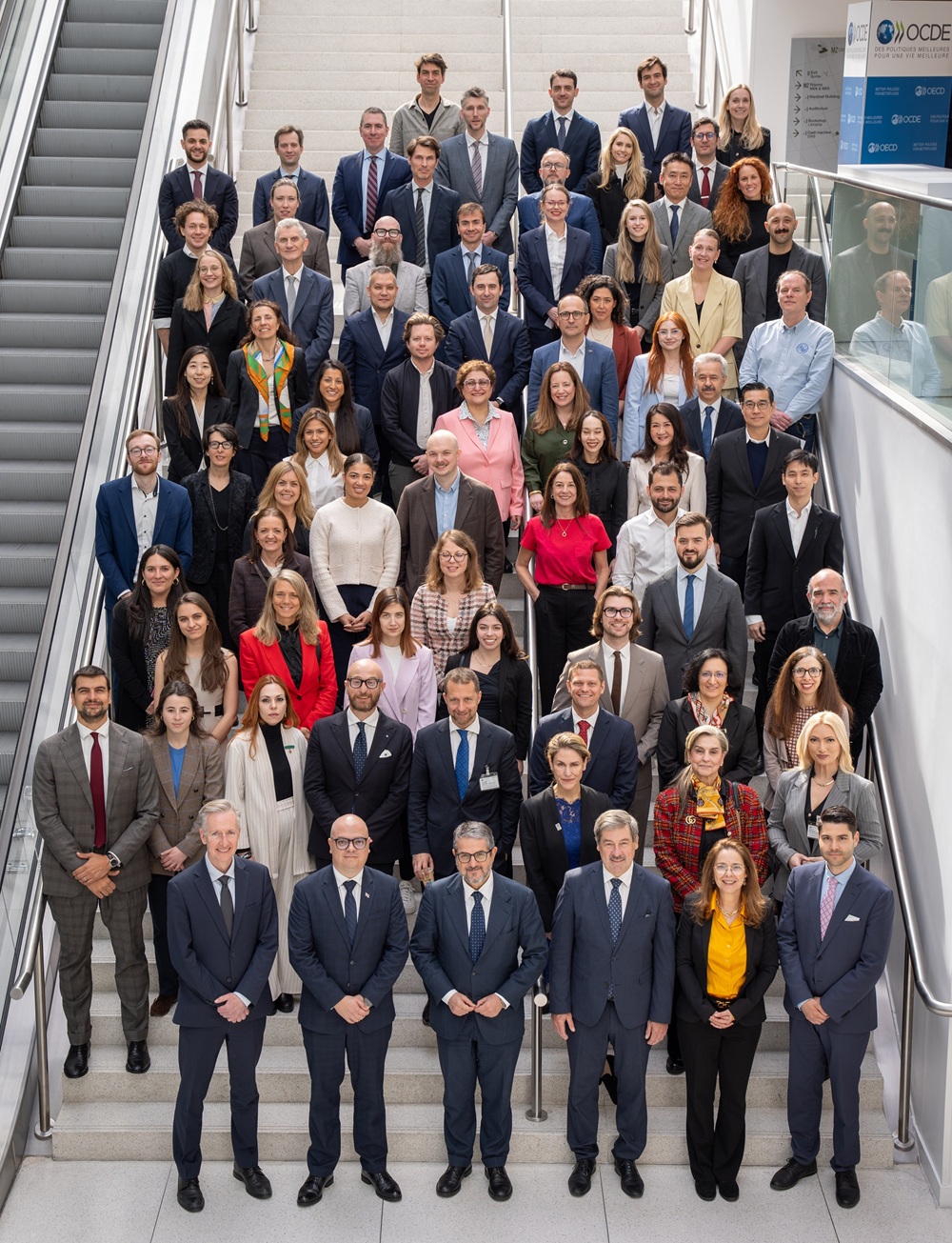
The objective was clear: how do we stop small businesses from being left behind as AI reshapes the global economy?
Governments, corporates and organisations like ours came together to work on a global policy toolkit for SME adoption of AI and digital technologies.
And what stood out most was the gap between policy ambition and what SMEs actually experience.
The Organisation for Economic Co-operation and Development (OECD) brings together governments, global technology companies, researchers and organisations like Enterprise Nation to shape international policy.
Its Digital for SMEs (D4SME) initiative convenes public, private and third-sector voices to tackle the challenges small businesses face in a fast-changing digital economy.
Enterprise Nation is an official knowledge partner of the OECD, contributing real-world insights and data that support evidence-based policymaking for small businesses.
Bringing the SME voice into global conversations
At Enterprise Nation, we spend every day working directly with small businesses across the UK, helping them navigate growth through access to finance, markets, talent and digital skills.
While the global conversation focuses on advanced AI systems and automation, the reality for most small businesses is more practical.
Business owners are not asking about agentic AI; they are asking where to start, which tools to trust, and how to save time and money.
Alongside delivering programmes, we are also actively engaged in shaping policy, working closely with the government and partners to ensure the voice of small businesses is represented in decision-making.
This is where Enterprise Nation plays a unique role, not just as a programme delivery partner, but as a bridge between policy, technology and the real-world needs of SMEs.
A global challenge: Trust, skills and confidence
Across the day, a consistent theme emerged. Small businesses understand the potential of AI, but adoption is still being held back.
The OECD highlighted persistent information gaps, low levels of digital security readiness and a lack of clarity around data use, privacy and risk.
These shape whether and how small businesses adopt AI in their day-to-day. We see the same patterns through our own work.
Many businesses are experimenting with AI, often starting with marketing or content creation, but hesitating when it comes to more sensitive areas, such as finance or customer data.
The issue is not a lack of interest. It is a lack of confidence.
This reinforces a simple but important point. AI adoption does not begin with tools, it begins with trust.
What the data tells us about AI adoption among SMEs
The OECD’s latest report, Empowering SMEs in the age of AI, sets out how small businesses are adopting AI and where the real gaps remain.
More than 60% of SMEs surveyed report using some form of AI, yet the vast majority are still at an early stage. Around three-quarters are classified as 'AI novices', relying on simple, off-the-shelf tools for isolated tasks rather than embedding AI across their business operations.
Over half of businesses report some benefit from AI, but only around one in five describe the impact as significant or transformational. The real gains come when AI is integrated across multiple functions, which only a small minority of SMEs are doing.
The report also highlights a widening gap between small and large firms. While adoption is increasing across the board, it is accelerating faster in larger organisations, increasing the risk that smaller businesses fall further behind in productivity and competitiveness.
The barriers are familiar: time, skills and cost. Trust and security are becoming more pressing too, with over one in five SMEs reporting a cyber incident, and nearly half operating with minimal or no cyber security measures.
Perhaps most striking is the gap in awareness and access to support. Only a small proportion of SMEs report benefiting from government digitalisation programmes, while the majority of non-users simply do not know what support is available.
The role of ecosystems in driving adoption
Small businesses do not adopt technology in isolation. They adopt it when they are supported by trusted platforms, relevant training, peer networks and accessible advice. When those elements come together, adoption accelerates.
Enterprise Nation was invited to share how we translate policy into practical support for small businesses, including our initiatives, Tech Hub, our work with Google and our wider digital skills programmes.
We were also asked to contribute to the discussion on how UK digital skills compare internationally, alongside colleagues from the Department for Business and Trade.
Tech Hub: A practical model for digital adoption
Our Tech Hub platform, delivered in partnership with organisations including Google, Sage, Dell Technologies and Square, is designed to simplify digital adoption for small businesses.
It provides a straightforward starting point. Businesses complete a short diagnostic, receive a personalised action plan, and are then guided towards the tools, training and support most relevant to their needs.
The model matters as much as the platform. Tech Hub shows how industry-led collaboration can reach SMEs that government programmes struggle to.
Since launch, almost 90,000 businesses have registered and over 4,500 have taken part in events, training and advisory sessions. Uptake has been the strongest in smaller towns and regional communities where access to support has traditionally been limited.
This is also reflected in programmes like Google AI Works, which bring practical AI training directly into local ecosystems across the UK. These initiatives show that when support is accessible, relevant and locally delivered, businesses are far more likely to engage.
Partnership in action
Our Tech Hub consortium partners, Google, Sage, Dell Technologies and Square, shape the tools, content and support businesses access. In addition, our work with OpenAI continues to develop how AI can be applied in practical business settings.
This model was reflected at the OECD roundtable itself, where organisations including Amazon, Microsoft, PayPal and Xero contributed to discussions on how technology can better support small businesses globally.
Neither government nor industry can solve it alone. Progress depends on collaboration across the ecosystem, and on learning that crosses borders.
From insight to action
The afternoon turned to action. A Policy Lab worked on the foundations of a practical toolkit to support SMEs to adopt AI effectively, safely and responsibly.
For Enterprise Nation, three priorities stand out:
Support must be practical: Small businesses do not need more high-level frameworks. They need clear, actionable guidance that they can apply immediately.
Skills and confidence must be the focus: Training works when it is embedded in everyday business activity, not bolted on.
Local ecosystems matter: Adoption is faster when businesses are supported in their own communities, alongside national initiatives.
The task for policymakers now is to move from strategy to delivery.
Enterprise Nation will keep supporting small businesses on the ground, working with partners on practical solutions, and pushing for policy that reflects how SMEs actually operate.
As the Director of Government and Partnerships at Enterprise Nation, the UK's largest small business community, we lead the charge in creating a dynamic two-sided marketplace that seamlessly connects small businesses with the support they need to thrive.
My passion for design, technology, and innovation drives our mission to revolutionise the business support landscape, making it more accessible, efficient, and impactful for entrepreneurs at every stage of their journey.
Every day, our team is dedicated to empowering start-ups and small businesses by providing timely and tailored resources that foster growth and success. We believe in the power of community and the importance of delivering the right support at the right moment.
I’m always eager to discuss how we can further enhance the Enterprise Nation platform and better serve the small business community. If you have any questions or ideas on how we can support your business, please don’t hesitate to reach out. Let’s work together to help small businesses succeed.
When I'm not building a marketplace I'm also the founder of Girls in movement, a not for profit that educates young girls in India - we have recently hit over 20,000 downloads on the podcast and launched an online store this year.
I've also just launched a Children's book called The Girl and Her Globe, so feel free to take a look: www.girlsinmovement.com
)