If the same people crowing “try using AI” were to write a pavlova recipe, it would simply say “use kitchen”.
Real founders with real challenges don’t care about AI any more than they do Microsoft 365. They don’t want to “learn AI” – they want to find out very specific ways to make very specific aspects of their very specific working lives easier, faster, better. So saying “you should be using AI” does nothing but make them feel irrelevant, disconnected, and demotivated. May as well tell them to use the Force for all the good it will do.
Is it any wonder the UK is languishing mid-table in AI adoption? Only 6% of our small businesses are using AI tools daily, the vast majority of which are just using them for text generation.
We’re Great Britain – we bloody love a revolution. The typical time taken between early adoption and national addiction of a new technology is one September. It’s not end-user apathy, technophobia, or Love Island driving the slow pick-up. We can’t even blame Brexit.
So let’s get serious. What is going on?
Well, firstly, a lot of the training sucks. It’s just bad. Research consistently finds that self-directed AI courses have completion rates below 15%. That’s worse than me with a new Netflix series.
To boot, most corporate training is unstructured, done outside working hours, and disconnected from IRL. This is in a world where, according to a LinkedIn survey, fewer than 5% of large-scale reskilling programmes advance far enough to even measure success.
And what of that 5%? Well, they might feel great leaving some course on prompt engineering, but they likely go back to a workplace with no governance, no process mapping, and no leadership alignment. So where does the capability go? They may as well have taken up a course in gin-making – at least their summer parties might feel the benefit.
That all assumes a stable tech, too. No shade to the 300 celebrity-endorsed brands of the past few years, but gin at least has stayed more or less the same for hundreds of years. AI tools change faster than a Reflecting Pool in 2026. In fact, Accenture found that 78% of executives say AI is advancing too fast for their organisation’s training efforts to keep pace. Obsolescence on delivery.
Even the UK government’s own pilot underperformed. The £7.4m Flexible AI Upskilling Fund offered SMEs half off the cost of AI training. Just 553 businesses applied against a hoped-for 4,000; only 327 were funded, and only 181 ever claimed. Of the £7.4m pot, a grand total of £381,096 was awarded. Can’t even give it away.
We will have to wait until 2030 to see how its free AI Skills Boost programme, targeting 10 million Brits, and which Enterprise Nation is now part of, does. So far, nearly 2 million courses have been completed, but many of the modules are 20 minutes long.
This is a handshake introduction to new tools – it will need to evolve to something more substantive to have any meaningful impact. As the BCC says, “a few click-through online AI courses will not do it – this is a generational education challenge”.
And that’s the point, and why we need to shut up about AI
We’re not trying to solve for AI adoption – we’re trying to solve for better business outcomes. Generic AI 101 courses create awareness but not capability.
Our head of finance, Helen Seidler, does not care about AI – she cares about speed and accuracy of reporting (I mean, like, really cares). If I said to her: “I’d like you to go on a Claude course”, she’d likely tell me – with the grace she is so famous for – to eff off.
But when I suggested there was an opportunity for her to create summary schedules faster through Connectors, where spreadsheets build themselves, she was all over it.
Because AI adoption is a workflow challenge, not a content challenge, it has to be anchored to real-world, every-day, is-this-my-life-now operations and metrics. That means using it for specific problems – time to first draft or reduction in rework – not course completions.
The Department for Science, Innovation and Technology (DSIT) is on board, too. It is clear that SMEs need more detail on real business use cases, because most don’t know how AI connects to their workflows or data. On top of that, Skills England’s diagnosis found poor employer understanding of what “AI skills” even means.
Show folk a new tool without context, and it’s a burden. Show them the same tool and how it specifically relates to what they do, and they become evangelists. Unbearably so, in fact.
So… what do we do about it? How do we turn the UK from also-ran to Dame Kelly Holmes? For a start, we have to make the training actually good.
Luckily for AI – although it might want to think otherwise in its semi-conscious state – training long predates it. So we need only examine what has worked well in the past and remember not to forget it when dealing with AI tools.
For us, that’s about six tried-and-trusted, done-it-before-will-do-it-again principles that actually work:
Training for one: Every business and every individual is unique, so the training plan should be too. AI tools can flex much more than humans – so have them adapt to you.
Start at the pain point: Identify a single bottleneck or time-suck rather than attempting a platform overhaul.
IRL outcome-anchored design: Define the critical, real-world outcome before assigning learning, and then measure pre-existing operational metrics, not completions.
Hands-on, theory off: Training should be something people practise and make mistakes with, not content they consume.
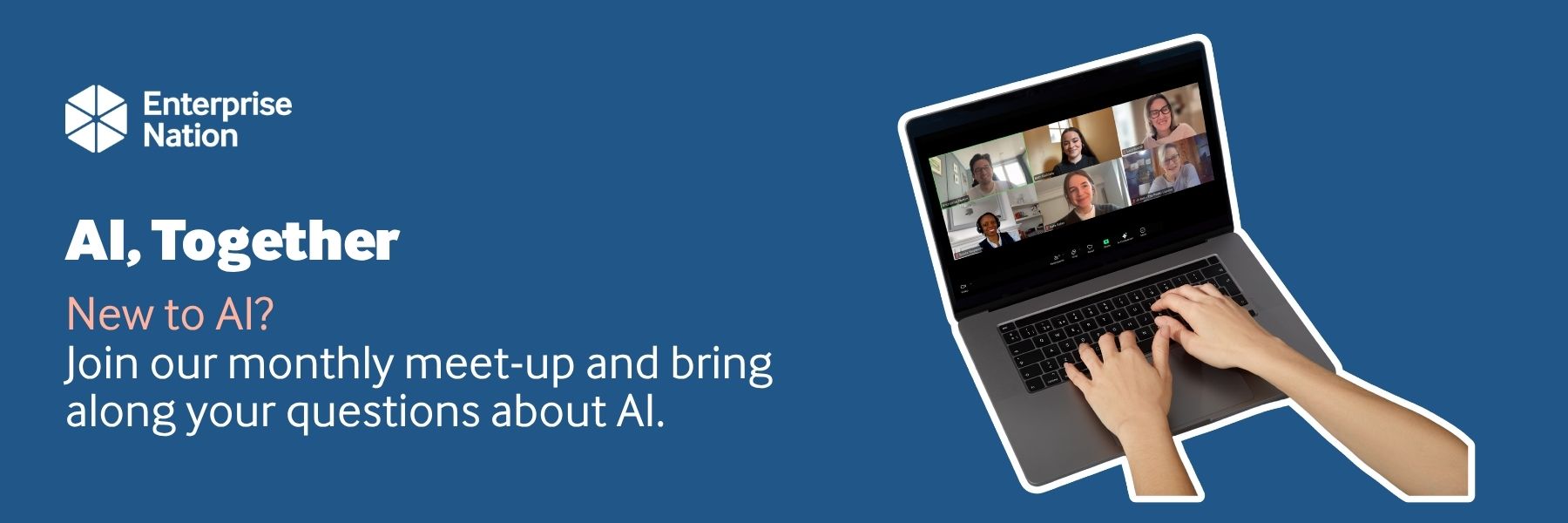
Learn with friends: Peer networks are the main source of support, contributing to small business growth. Socialise your experience. That’s why we’re launching AI, Together – a community space for folks on an AI skills journey.
Have a reason: People need to feel motivated to do something new. Maybe it’s more sales, maybe it’s fewer working hours, maybe it’s a free bagel. But have a clear reason, or nothing will happen.
We’re using AI tools more and more at Enterprise Nation. But it was a slow start for us, and not least because the tech kept changing so much – knowing which horse to back and for which race is never, as my betting streak will attest, a sure thing. But we kept at it, trying to find ways it could be genuinely helpful.
And now we’re really getting somewhere with it. Claude Code has been a super serum for our already-buff engineers. Our ability to analyse performance data is faster and deeper than ever. Administration time is going down, and time spent on the human-only stuff – pop-up shops, podcasts, community meet-ups, and so on – is going up. And we’re now even building AI-led products of our own.
It is absolutely worth doing. The transformative potential is real. But we, as a nation, have to stop talking about it and figure out the best way to actually do it.
AI, Together is a small, friendly group for Enterprise Nation members who are new to AI and would rather explore it with good company than on their own. Sign up for the next event on 31 July!
Aaron Asadi is a high-impact entrepreneurial business leader with a proven track record of launching and scaling powerful digital businesses. As the CEO of Enterprise Nation, he brings over 15 years of senior executive experience in technology and e-commerce strategy – most notably at Future plc and Saga Media.
At Future plc, Aaron held multiple senior leadership roles including managing director of e-commerce. He was responsible for a $150 million global P&L, leading growth strategies that boosted audiences to 500 million and delivered record-breaking revenues across consumer tech, music, and photography sectors.
As CEO of Saga Media, part of the FTSE listed Saga Group, he launched a new digital division from scratch – delivering a bespoke web platform with two million monthly sessions and a growing and engaged community.
Aaron has repeatedly designed innovative models and driven growth in both B2B and B2C environments. He's a specialist in growing online audiences, creating compelling knowledge platforms, SEO strategies, and sustainable models – and now channels his passion and deep knowledge into supporting the next generation of entrepreneurs and the five million small businesses in the UK.
)