Beauty, tech and boardrooms: South Asian founders building beyond the family trade
Posted: Thu 16th Jul 2026
16 min read
Part two of the series shines a light on Enterprise Nation members and South Asian founders who are breaking new ground in beauty, tech and business.
In part one of this series, we heard from South Asian founders whose businesses trace straight back to family – all of it inherited, more or less directly.
This second instalment picks up where that inheritance takes them somewhere new: beauty counters, tech platforms, and the kind of high-level PR and investment work that, a generation ago, would have seemed a world away from where these founders' families began.
That same instinct – taking what you inherited and pointing it somewhere new – is what led me to start
, the not-for-profit I run alongside my day job as COO of Enterprise Nation.
It began with stories my grandmother told me, and her belief that girls could build things too, long before anyone was handing them a seat at the table.
She'd never have called it entrepreneurship. But reading what the founders below have built, taking their families' example somewhere their parents' generation never had access to, I think she'd recognise exactly what they're doing.
1. Harsha Harjani, founder of Caine Strategies
Not every founder starts a business straight away.
Around 11% of the UK's self-employed business owners identify as being from a minority ethnic group, but the path there is rarely a straight line – plenty spend years, even decades, in conventional careers before entrepreneurship catches up with them.
Harsha Harjani spent 20 years in in-house communications, the first in her family to go to university, and built a career that reached the director-of-communications level in London.
Her background is Sindhi, a community where most families, including her own, were in trading, proud of being business owners. For years, Harsha painted herself in a different light and walked a different path.
Now, setting up Caine Strategies, she finds herself doing exactly what her ancestors did: taking a stab, believing in herself, persevering, and admiring, more than ever, how effortlessly they seemed to think big.
She says:
"Here I am, setting up my own business, being true to my roots and realising how difficult it is to set up, take a stab, believe in yourself and persevere to keep going."
Caine Strategies is a service business rather than a product one. It supports founders and small businesses with PR.
Harsha draws on 25 years of experience doing the same for large corporates, alongside consulting work helping large listed companies communicate sustainability as a strategic advantage and a story of business resilience.
Her advice leans hard into that inheritance:
"Take the time you need to narrow your ideas down to one or two, but if you're already clear, go all in.
"Think carefully about how you want to position yourself, but test as you go and don't get stuck in analysis paralysis."
And if you're Asian, she says, know that entrepreneurship runs in your blood:
"Your forefathers took the risk of starting new lives in new places, so follow in their footsteps, and when the voices of doubt show up, let them be, and wait for the voice that tells you to keep going.
"If you don't believe in yourself, no one else will."
2. Anuuj Kohli, founder of EB London
South Asian business hasn't just shaped restaurants and retail, it's shaped investment into Britain itself.
A study of Asian-owned businesses in London alone found they generate nearly £2.7 billion in turnover and support close to 15,000 jobs, with 265 Indian foreign direct investment projects set up in the capital over a decade, accounting for 11% of all inward investment projects into London.
Anuuj Kohli is part of that story. He founded EB London, a premium, British-only lifestyle and interiors platform, after a 20-year career in furniture and luxury retail.
A core pillar of EB London is its partnership with the Akshaya Patra Foundation: every single sale funds a meal for a schoolchild.
Anuuj says:
"This commitment to embedding charitable giving into the DNA of the business stems directly from the cultural values of giving back and supporting the wider community."
Building an uncompromising business model has taken real discipline.
EB London operates on a strict 100% "Made in the UK" mandate, a commitment that gets tested every time supplier networks and commercial pressures make it tempting to cut corners.
Standing firm on provenance and on a "buy less, buy better" philosophy has been one of the business's defining milestones.
Anuuj advises:
"Value structure, focus, and unwavering accountability over short-term wins.
"When you scale a business, do not just aim for rapid growth — build it on a foundation of clear data, solid logistics, and strong core values. Decide what your brand stands for early on, and do not let market noise dilute your strategy."
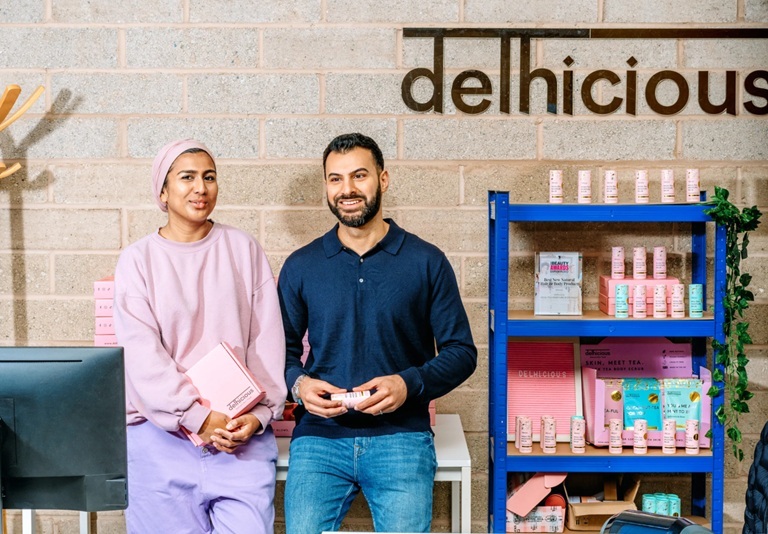
3. Zara Saleem, co-founder of Delhicious
Beauty is the newest frontier for this same heritage. Ayurvedic and Indian-inspired beauty brands have gone from niche to genuinely global in the space of a few years.
Brands like Fable & Mane, founded by British siblings of South Asian heritage, have gone viral and landed in Sephora and Boots, while Estée Lauder's decision to take full ownership of the Ayurvedic beauty house Forest Essentials signals just how seriously the mainstream beauty industry now takes this category.
Zara Saleem built Delhicious out of exactly that inheritance. It didn't start as a business plan; it started with her mum and grandmother's recipes, sitting in her kitchen while she was on maternity leave.
What Zara wanted to build was the beauty brand she never saw growing up: one that represented girls and women like her. Every formula traces back to remedies passed down to her long before skincare was ever a career plan.
She explains:
"My heritage isn't a marketing angle for us; it's the actual foundation.
"The Ayurvedic ingredients, the rituals, the stories – that's not something we bolted on after the fact to sound authentic. It's genuinely where the brand began, and it's still what guides every product we launch."
Going viral turned out to be its own kind of challenge. The growth was incredible, but it exposed how much still needed to be built behind the scenes: subscription economics, retention, and marketing infrastructure.
Zara went through a real turnaround period, getting honest about where the business was leaking margin, rebuilding email flows and the subscription model from the ground up, and making hard calls, including parting ways with an agency that wasn't serving the brand well.
She notes:
"It was humbling. But learning to read the numbers as closely as I once relied on instinct made me a much stronger operator."
And her advice for the next generation:
"Don't wait until your story feels 'polished' enough to share, since the specificity of where you come from is your biggest advantage, not something to sand down to fit a category.
"Get comfortable with the unglamorous parts early, too.
"Virality and community love will only take a business so far if the operational backbone, the margins, the retention, and the systems aren't solid underneath it. Build both at once, and don't be afraid to ask other founders who've been through it for help."
That community, she points out, has mattered more than almost anything else.
4. Saman Ali, founder of Beauty Cleanse
That same instinct to reach back into heritage is reshaping skincare too, and the market is following: the UK's clean beauty sector alone is projected to grow from around £290 million in 2023 to nearly £780 million by 2030, as consumers move away from trend-driven routines and towards simpler, ingredient-led formulations.
Saman Ali built Beauty Cleanse at exactly that turn. After years working as a project analyst, she left the corporate world behind after experiencing what she calls "modern skin burnout" – skin overwhelmed by stress, trend-driven routines and constant product switching.
Growing up surrounded by generations of women who treated skin as something to care for patiently rather than fight, and later exploring Japanese, Mediterranean, Turkish and Egyptian beauty traditions, Saman realised the philosophy was universal: ancient women across cultures weren't chasing flawless skin, they were supporting balanced, resilient skin through nature and consistency.
Beauty Cleanse's hero product, Pink Ubtan, reimagines the centuries-old South Asian Ubtan ritual, a botanical paste traditionally used as a pre-wedding glow treatment, into a modern water-activated cleanser and mask.
She says:
"Long before 'upcycling' became a trend, I watched women in my family transform what others considered waste into something valuable, a mindset that inspired us to upcycle surplus superfoods into high-performance skincare today.
"Your heritage is a source of perspective, not limitation. Some of the most meaningful innovations come from respecting where you've come from while having the courage to reimagine it for the future."
5. Lamees Butt, co-founder of RISER
Tech is where this heritage is arguably most under the radar.
There's real room left to grow, which is exactly the gap Lamees Butt is building into.
Growing up in a South Asian household, one thing was drilled into Lamees early: work ethic. There wasn't much to go around, and she learnt fast that if she wanted something, nobody was going to hand it to her; she'd have to go and get it herself.
At 15, that meant a first job sweeping hair off a salon floor for £25 a day. It doesn't sound like much now, but at the time, it was life-changing, a taste of freedom she became addicted to.
Heritage gave her something else too: a sharp awareness of her own unconscious bias, born from knowing exactly what it felt like to be on the receiving end of someone else's, people stumbling over her name, or making assumptions about her because of where she grew up.
She reflectes:
"That awareness became my superpower. Every time I hit a wall, a rejection or something that didn't match my expectation, I learnt to sit with it just long enough to ask one question: what's the next move?"
That question turned out to be the real story behind Lamees's career, and it was never a straight line. She dropped out of a law degree to build her first company at 19 (her parents' reaction can be imagined).
When that company failed at 21, and the usual job channels didn't work out, she stopped trying to land a job the conventional way and started making things instead, sending them straight to the people hiring.
She says:
"Looking back, I can see it now. Every messy, sideways step was quietly building toward RISER."
RISER is the app Lamees built to make sure career connections aren't left to chance. After a decade working in AI, she's become genuinely obsessed with what data can do at scale when it's used to actually serve people, rather than automate them out of the picture.
She says:
"Human discovery matters to me because access mattered so much to me.
"It was a battle I shouldn't have had to fight, and today, poor use of AI is making that battle harder, flattening everyone into the same templates, the same keywords, the same sea of sameness.
"The way you win in this new world is by refusing to blend in."
RISER exists to help people do exactly that: stand out, be found, be themselves, and turn that into opportunity.
What strikes me with these founder stories is how little separates a fintech platform from a spice brand, or a skincare line from an interiors business, when you trace them back to their origins.
Nearly every founder here points to the same source: a parent or grandparent who built something from very little and made resilience look ordinary rather than extraordinary.
That's the real inheritance. Not a recipe, or a trade, or a set of contacts, though those help, but a template for what's possible when you back yourself the same way your family once did.
South Asian Heritage Month is a chance to say that out loud. To the hundreds of thousands of South Asian and ethnic minority business owners already contributing tens of billions of pounds to the UK economy every year, and to whoever's sitting in their kitchen right now, quietly turning a grandmother's recipe over in their head: thank you, and keep going.
As the Director of Government and Partnerships at Enterprise Nation, the UK's largest small business community, we lead the charge in creating a dynamic two-sided marketplace that seamlessly connects small businesses with the support they need to thrive.
My passion for design, technology, and innovation drives our mission to revolutionise the business support landscape, making it more accessible, efficient, and impactful for entrepreneurs at every stage of their journey.
Every day, our team is dedicated to empowering start-ups and small businesses by providing timely and tailored resources that foster growth and success. We believe in the power of community and the importance of delivering the right support at the right moment.
I’m always eager to discuss how we can further enhance the Enterprise Nation platform and better serve the small business community. If you have any questions or ideas on how we can support your business, please don’t hesitate to reach out. Let’s work together to help small businesses succeed.
When I'm not building a marketplace I'm also the founder of Girls in movement, a not for profit that educates young girls in India - we have recently hit over 20,000 downloads on the podcast and launched an online store this year.
I've also just launched a Children's book called The Girl and Her Globe, so feel free to take a look: www.girlsinmovement.com
)