It's in the DNA: The South Asian founders rewriting Britain's small business story
Posted: Tue 14th Jul 2026
17 min read
This is part one of a two-part series spotlighting money, food and family values, celebrating South Asian Heritage Month with Enterprise Nation's founders.
Ask a South Asian founder where their business really started, and hardly any of them point to a business plan.
They point to a kitchen, a grandmother's recipe, a market stall watched from a parent's shoulders, a grandfather who arrived in Britain with a suitcase and started again from nothing, because that's simply what you did. It's a pattern with real weight behind it.
Entrepreneurship, for so many South Asian founders, isn't something they discovered; it's something they inherited.
This July, for South Asian Heritage Month, we asked our members to share those stories with us: what shaped the business, what nearly broke it, and what they'd tell the next generation.
What came back was a set of founders building genuinely different things – all pulling from the same deep well: family, food, resilience, and the quiet example of people who took risks long before anyone was writing about entrepreneurship as a career choice.
This first article starts where the inheritance is most direct: money and food, passed down through family. It's personal for me too. As COO of Enterprise Nation, I spend my days surrounded by founders' stories, but these sit closer to home than most.
My own family came to the UK from India and built businesses here from nothing, the same quiet, relentless graft that runs through every story below.
Girls in Movement, the not-for-profit I founded, traces back to my grandmother, to the stories she told me and the belief she had that girls could build things too, long before anyone was handing them a seat at the table.
Reading what's shared here, I recognise so much of it: the family expectations, the instinct to build something useful out of what you were given, the grandparents who make it all look easier than it was.
I don't think that's a coincidence. I think it's the same inheritance, showing up in a different generation.
1. Varun Aggarwal, founder of Know Your Dosh
Nowhere is that clearer than in money. In South Asian households, one family member – usually a parent – often manages everything alone, with everyone else kept at arm's length from the details.
It's a familiar enough pattern that Varun Aggarwal built an entire business around fixing it.
Varun grew up in India and lost his father at 14. His father had managed the family's finances alone, and when he died, they struggled to even locate his accounts, let alone manage them. Part of his wealth was lost simply because no one else knew it existed.
That experience became the founding reason for Know Your Dosh, a platform that lets families manage money together, securely and transparently, so no one else has to go through what Varun's family went through.
He says:
"The instinct to protect family, and the reality that financial silence often causes more harm than good, is something I think many South Asian founders will recognise immediately."
Like many first-time founders, Varun made what he now calls a classic mistake: pouring everything into building the product, and very little into finding out whether anyone actually wanted it.
A mentor gave him a hard truth:
"Without users, you never really know if people want what you've built, or would pay for it."
Taking that on board meant painful decisions, including a significant reduction in headcount, just to survive. It was, in Varun's words, one of the hardest periods of building the business, with a real chance it wouldn't make it through.
It did. And the discipline forged in that period is directly behind where Know Your Dosh stands today: 14% month-on-month growth for 15 consecutive months, families in over 100 countries, and all of it without spending a penny on paid marketing.
He advises:
"Don't let the fear of disappointing your family or community stop you from building something uncertain. Some of the most meaningful businesses come directly from the problems our own families and communities have quietly struggled with for generations."
His second piece of advice is simpler, and harder to follow:
"Listen to the feedback that stings the most."
It was the advice Varun least wanted to hear that ended up keeping his business alive.
2. Krunal Mistry, co-founder of Tastesmiths
Money is one inheritance. For the next founder, it was flavour.
Food is where South Asian entrepreneurship in Britain is most visible, and the numbers back that up: the curry industry alone is estimated to contribute around £4.5 billion to the UK economy every year, spread across roughly 12,000 Indian and South Asian restaurants and takeaways nationwide.
That's before you count the newer wave of packaged food and drink brands taking those same flavours into supermarkets and shelves that the older generation never had access to.
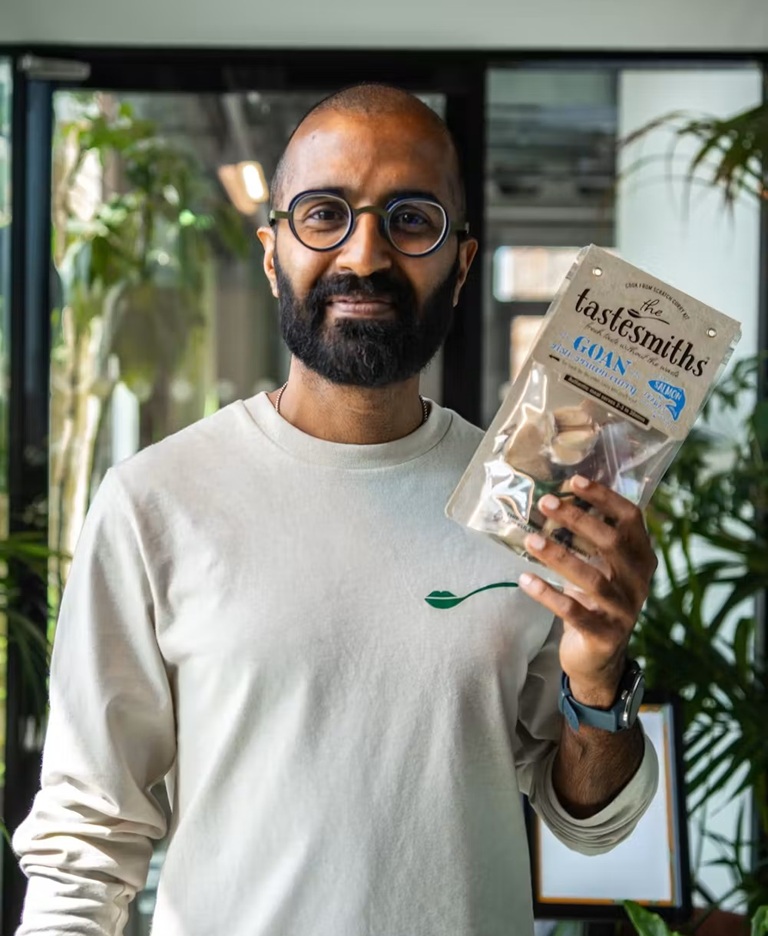
Krunal (Kru) Mistryis part of that wave. Tastesmiths is a British Asian, family-run business, run alongside his two siblings, making fresh curry kits designed to help people cook proper, flavour-packed meals at home without the faff.
Food was central to his heritage long before it became a business. Growing up, Kru's mum cooked most nights, and mealtimes were about family, generosity and pride in cooking from scratch.
But Kru also saw how hard it was for people to recreate that depth of flavour at home. It's a big part of why so many people end up going out for an Indian, or settling for a takeaway instead.
Kru says:
"Tastesmiths was born from that tension: wanting to honour proper cooking and real ingredients, while making it easier and less intimidating for people to cook fresh, delicious food themselves."
However, one of the hardest parts of building the business has been helping people understand what actually makes it different.
It's not a jar of sauce, and it's not a spice mix; it's the only meal kit company built around fresh ingredients and proper cooking technique, which means the category itself doesn't neatly exist yet.
As a founder, that's meant constantly explaining, refining and proving the business's value from scratch. Hard, but energising too, because it meant Kru and his siblings are building something genuinely new.
Kru advises:
"Don't feel like you have to choose between your heritage and building something modern. Your background, your family stories, your food, your culture and your lived experience can all be strengths."
At Tastesmiths, that's meant pairing classic, familiar dishes like Tikka Masala alongside more traditional flavours like Makhani, and showing the range of vegetables that can be paired with curry beyond the usual suspects.
But heritage alone isn't the whole answer, Kru is quick to add:
"Build something with real value, understand your customer, stay consistent, and be prepared to keep going when it's harder than you expected.
"There's power in bringing your whole self to the business, but you still have to do the work."
3. Steve Sailopal, co-founder of Curry Smugglers
That same food heritage is now pushing into categories it was never allowed near before.
Self-employment among working-age South Asian adults in the UK sits well above the national average – 16.2% among Pakistani and Bangladeshi adults compared with 13.3% nationally – and increasingly that entrepreneurial energy is landing in mainstream retail, not just restaurants: bold, branded, shelf-ready products built to sit next to any other modern FMCG brand.
Steve Sailopal is taking those same flavours somewhere they've rarely been allowed to sit: the snack aisle, in a bold, recyclable can, proudly branded rather than hidden.
Steve co-founded Curry Smugglers with his wife, Ruby. A first-generation British Asian founder, originally from East London and now based in Kent, he spent much of his career building challenger food and drink brands – including a spell in brewing and alcohol-free beer – before moving into snacks.
He says:
"South Asian food culture has always been full of flavour, colour, noise, family, stories and personality, but the snack aisle has not always reflected that.
"We wanted to take the snacks we grew up with and give them the spotlight they deserve, rather than leaving them stuck in clear plastic bags or hidden away in the world food aisle."
For Steve, the hardest thing hasn't been the product; it's been the perception.
Getting people to see South Asian culture as current, creative and commercial, not just traditional or nostalgic, has meant constantly backing the idea that the flavours, stories and culture behind Curry Smugglers don't need to be softened, hidden or explained away.
He advises:
"They can sit proudly on modern shelves, in Selfridges, in delis, in bars, and in places people might not expect.
"Don't wait for permission to take up space. Build the thing properly, make it sharp, make it commercial, but don't strip out the culture just to make other people comfortable. That's usually the magic."
4. Sanjay Aggarwal, co-founder of Spice Kitchen
Nowhere is the generational pattern clearer than in family businesses started as something small and grown into something else entirely.
In Bradford, one of the UK's most concentrated South Asian business communities, around half of all new start-ups in the district are founded by South Asian people – a community estimated to be four times more likely to start a business than the national average.
Sanjay Aggarwal built exactly that kind of business with his mum. He co-founded Spice Kitchen with Shashi in 2012, a small family business that started as a retirement hobby for her and has since grown into a brand sold online and through a network of over 600 retailers across the country.
In 2023, Sanjay released his first cookery book, Spice Kitchen, and later released it in the US, which was named one of Waterstones' Best Books of 2023. His second book, Essential Spices for Dummies, is due from Wiley.
Sanjay and his mum have cooked for the CEO of eBay and appeared on The Hairy Bikers.
He was invited into the 42 Under 42 business club for entrepreneurs in the North West, completed the Goldman Sachs 10,000 Small Business Alumni Programme, and now mentors other small businesses as an export champion with the DIT and a board member of the Brett Centre for Entrepreneurship at the University of Liverpool.
Spice Kitchen's products have picked up a string of awards along the way, including the Great Taste Award and Gift of the Year, for several years running.
He notes:
"Don't underestimate the value of your own story. The things that make us different are often the things that resonate most deeply with other people."
5. Falguni Patel, speaker and mentor
Behind many family businesses sits a woman who was never formally "the founder" but ran things all the same.
It's a pattern the data confirms: a London study of Asian-owned businesses found that a third are owned by women, and well over half have at least one female director– a marker of exactly the entrepreneurial rise so many South Asian founders grew up watching first-hand, often without anyone calling it that at the time.
Falguni Patel watched her own mother live this pattern. Growing up, she saw her mum hold down a full-time job while also working in the family shop and running various side hustles, teaching Falguni, from her teenage years, about multiple income streams and building assets.
She notes:
"My mum was an influencer, before the word influencer was trendy.
"I would organise events, and she would be the one who would fill them – that's when I realised the different qualities of team members required within a business: those who create, and those who actually influence and sell."
Education came first in Falguni's household, as it does in so many South Asian families. She graduated with a degree in biochemistry and microbiology, with her parents convinced a steady job would always beat the uncertainty of owning a business.
Childhood visits to India added another layer of education entirely, watching street vendors and shop owners, many with no formal education at all, compete for business and read a customer in seconds.
As Falguni points out, look across the South Asian community, and you'll find the majority have run some form of business at one time or another; many still do.
Being visible and building a personal brand didn't come as easily. In a culture where women aren't always expected to be seen or heard, speaking up, networking and talking about her own achievements was something Falguni did for a long time without ever putting her face to it.
Understanding why that needed to change, particularly as a speaker and mentor, took real clarity and real courage to work through.
Her advice for the next generation:
"Work on your personal branding.
"Don't be afraid to ask for help, especially from friends and family, and build a support system you can turn to, because businesses don't always go to plan.
"Be flexible, since your business plan is not set in stone, and remember that making mistakes is part of the journey – so don't be too hard on yourself."
6. Sangeeta Sengupta, founder of TiffinWalli
Not every business built from heritage is measured in revenue alone.
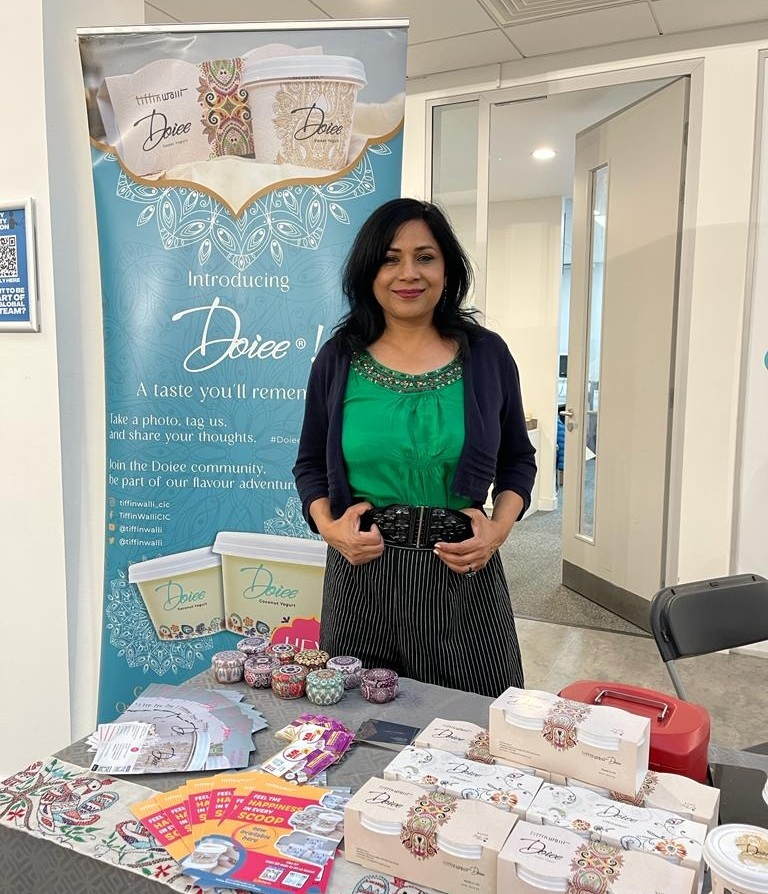
Sangeeta Sengupta built TiffinWalli to sit at the intersection of that problem and another one: the migrant and marginalised women in her East London community who had real cooking skills and deep food knowledge, but faced barriers to formal employment that mainstream jobs weren't flexible enough to accommodate.
TiffinWalli began by creating catering opportunities and helping women expand their skills beyond the dishes they already knew, into professional food preparation, food safety, and working as part of a catering team.
It's Doiee Yoghurt, developed from a traditional Bangladeshi style of yoghurt, was built to honour that heritage while becoming a high-quality product for a wider market.
A third strand of the work tackles health inequality directly, through workshops that help families see how small changes to familiar meals can improve health without giving up their culture or traditional food.
She says:
"My heritage has helped me understand that culture should not be seen as a barrier. It can be a strong foundation for creating employment, developing products and improving community health."
Growing a social enterprise built around flexible, accessible work for women with limited formal employment experience has meant growing at a different pace than a typical business.
Access to premises, funding and professional networks has been a recurring obstacle, and progress hasn't always been fast. But watching the women TiffinWalli supports grow in skill and confidence, Sangeeta says, is what makes the slower path worth it.
She advises:
"Create your own definition of success. A successful business is not only measured by income or how quickly it grows.
"It can also be measured by the opportunities it creates, the people it supports and the positive change it leaves for future generations."
Money managed in silence, flavour taught at a stove, a family shop turned into a network of 600 retailers, a mother who was running the numbers long before anyone called her a founder, and a business built to feed people better rather than just feed them – six different starting points, all running on the same instinct: take what your family gave you, and build something useful out of it.
That's only half the story. In part two, we meet the founders taking that same inheritance somewhere it's rarely been allowed to go before: beauty counters, tech platforms, boardrooms, and PR strategy for some of the UK's biggest listed companies.
As the Director of Government and Partnerships at Enterprise Nation, the UK's largest small business community, we lead the charge in creating a dynamic two-sided marketplace that seamlessly connects small businesses with the support they need to thrive.
My passion for design, technology, and innovation drives our mission to revolutionise the business support landscape, making it more accessible, efficient, and impactful for entrepreneurs at every stage of their journey.
Every day, our team is dedicated to empowering start-ups and small businesses by providing timely and tailored resources that foster growth and success. We believe in the power of community and the importance of delivering the right support at the right moment.
I’m always eager to discuss how we can further enhance the Enterprise Nation platform and better serve the small business community. If you have any questions or ideas on how we can support your business, please don’t hesitate to reach out. Let’s work together to help small businesses succeed.
When I'm not building a marketplace I'm also the founder of Girls in movement, a not for profit that educates young girls in India - we have recently hit over 20,000 downloads on the podcast and launched an online store this year.
I've also just launched a Children's book called The Girl and Her Globe, so feel free to take a look: www.girlsinmovement.com
)