How small firms can win more public sector work: Insights from CCS's Meet the Buyer day
)

Posted: Mon 15th Dec 2025
9 min read
Enterprise Nation's Maggie Berry OBE recently joined Crown Commercial Service's (CCS) SME Meet the Buyer event in London, speaking on a panel about how smaller firms can work with government and its strategic suppliers.
Here's a round-up of the day and the main issues discussed.
A focused day on SMEs and public procurement
The event at 20 Cavendish Square brought together SMEs from London and the surrounding area, central and local government buyers and established public sector suppliers.
The aim was to give smaller firms practical support on entering public sector supply chains through:
content sessions on frameworks, the new Procurement Act and social value
one-to-one meetings with commercial leads from government
time with large "prime" suppliers to explore subcontracting and partnership options
networking between SMEs to encourage bids from potential consortiums
Maggie joined the supplier partnership panel, chaired by CCS SME business adviser Henry Brysh, alongside senior leaders from Valtech, AtkinsRéalis, Mitie and tecknuovo, to share the small business perspective.
Government's direction of travel – buy more from SMEs
Shirley Cooper OBE, the government's SME Crown Representative, set the tone. There are 5.6 million businesses in the UK and 99% of them are SMEs, supporting around 27 million jobs.
Against that backdrop, the government spends around £385 billion a year on goods and services and wants to see much more of that flowing to smaller firms.
Across Whitehall, there are an estimated 36,000 buyers. Departments may all operate differently, but the shared directive is now clear – buy more from SMEs.
The Home Office gave a concrete example. Its chief commercial officer Lee Tribe said the department wants to double its spend with SMEs, moving from roughly 5% to 10%, and is also looking to drive up indirect SME spend by pushing primes to work with smaller suppliers.
His message to SMEs was blunt but encouraging – when a small business wins a contract, it's because they're judged to be the best, not because they're small.
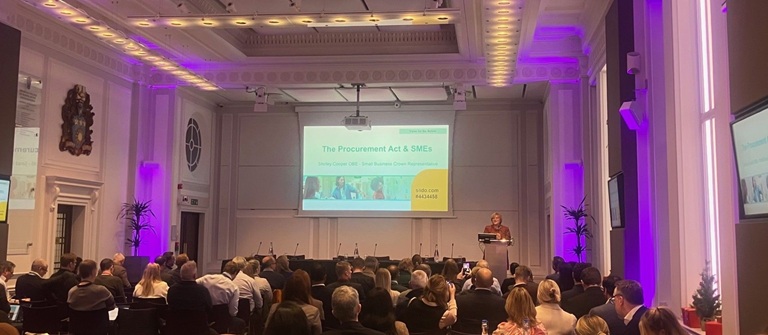
Procurement Act 2023: A new framework for SME access
A lot of the discussion centred on the Procurement Act 2023 (the Act), which went live in February and is now starting to shape behaviour.
Shirley described the Act as a once-in-a-generation change to the law that places SMEs "front and centre" of public procurement. She called it "a game changer for smaller suppliers".
For her, the two most important words in the Act are "have regard".
Contracting authorities must have regard to the barriers SMEs face in taking part in procurement and consider whether those barriers can be removed or reduced. This is intended to help level the playing field.
Maggie's takeaway was that SMEs should be optimistic but realistic about timing.
Many current frameworks are still running on terms set before the Act. CCS expects some agreements not to be fully refreshed until 2027 and others to continue until 2029.
As a result, most people in the room felt the real impact will start to show over the next 12 to 18 months rather than immediately.
CCS, frameworks and getting the basics right
From a CCS perspective, Kate Wood encouraged SMEs to see CCS as a helpful middleman.
Supplying indirectly via primes, she said, is often a very good way to get into government supply chains, although there's usually limited room to negotiate the "flow down" terms that primes pass on.
Her practical advice for SMEs included:
making sure you're on the right CCS framework for your products and services
knowing your CPV (Common Procurement Vocabulary) code so buyers can find you more easily
reading the bid questions and evaluation criteria carefully, and writing in a way that makes it as simple as possible for buyers to score your response
using LinkedIn actively to follow CCS frameworks, government buyers and relevant events
Kate also stressed that SMEs shouldn't put up with poor treatment from larger suppliers.
Any firm that encounters problems in how primes deal with their SME partners can contact the Procurement Review Unit – which acts as the "procurement police" – or reach out to Crown Representatives for help.
What Maggie's panel said about working with primes
On the supplier partnership panel, Maggie and her fellow panellists explored what successful SME–prime relationships look like in practice.
Several messages stood out:
SMEs are usually closest to their clients and products, which gives them an edge when it comes to being innovative and responsive.
Larger organisations are highly risk-aware and can have "glacial" governance, which can slow decisions but also creates space for nimble SME partners.
SMEs need to be clear on the specific value they add to a partnership and equally clear on their profit margins over the full life of any deal.
The panel also acknowledged a consistent problem – visibility.
Many SMEs struggle to get in front of the right people in departments and in primes, or to know which frameworks and routes to market they should prioritise.
AI, digital pipelines and where future opportunities sit
Technology and AI were recurring themes.
From CCS's technology team, Jammar Prince spoke about government's desire to "regenerate the AI market in the UK", underpinned by £550 million of public investment.
A significant part of this will flow through CCS commercial agreements.
Jammar pointed out that many agreements are still running under previous legislation and will only gradually be updated in line with the Procurement Act 2023, with some frameworks running until 2029. This reinforces the message that SMEs should think in years, not months.
Defra's Shayla Hastings highlighted a specific opportunity. ADMS Dynamic is a £300 million digital delivery pipeline where the department is looking for "digital native" SMEs to deliver services.
Practical steps for SMEs
Across the day, a clear set of actions emerged for SMEs that want to sell into the public sector, either directly or via primes:
Engage early: Use pre-market engagement sessions, Meet the Buyer events and published procurement pipelines to get in early and understand future opportunities.
Be visible: Make sure you're present on the right CCS frameworks, keep your information up to date and use LinkedIn and sector networks so buyers and primes can actually find you.
Know your numbers: Track your profit margins over the full term of any contract and understand how flow-down terms from primes will affect you.
Use the support on offer: Draw on CCS guidance for SMEs – including resources such as its modern slavery guidance for suppliers – and reach out if you face poor practice from larger partners.
Be patient and persistent: Change under the Procurement Act will arrive in phases. Most speakers expected meaningful shifts over the next 12 to 18 months, not overnight.
As Shirley Cooper put it, SMEs will be central to the innovation and value the government is looking for.
The direction of travel is in their favour, but it will reward those who are visible, engaged and prepared to stick with it.
Where Supply Connect comes in
For SMEs that want to work with government's strategic suppliers, Supply Connect exists to bridge that gap, connecting smaller firms to primes that hold major public contracts and are actively looking for SME partners. Register now
Get business support right to your inbox
Subscribe to our newsletter to receive business tips, learn about new funding programmes, join upcoming events, take e-learning courses, and more.
Start your business journey today
Take the first step to successfully starting and growing your business.
Join for free