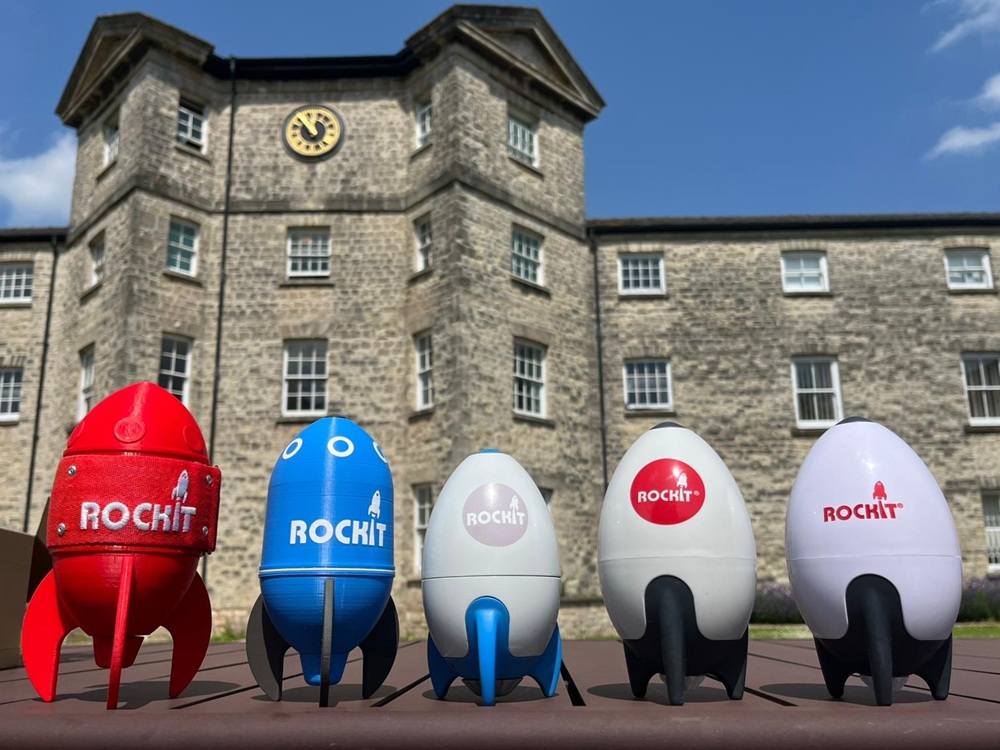
One million Rockers: The steady approach that built a global baby brand
Posted: Wed 8th Jul 2026
7 min read
With just five core employees and a commitment to careful growth, Rockit has won two Queen’s Awards and quietly sold one million baby rockers worldwide. We spoke to co-founder Matt Dyson (below) about how to build a successful product business.
When Matt's brother-in-law, Dr Nick Webb, showed him a device assembled from old printer parts over Christmas 2015, the product design teacher saw something special. Special enough that barely a week later, he walked into school and handed in his notice.
Last month, that leap of faith reached a significant milestone: Rockit, the Bristol-based baby sleep brand they built together, sold its one millionth unit. The company now holds two Queen's Awards for Enterprise – in innovation and international trade – exports to over 40 countries and has established itself as a leader in the baby sleep market. Yet the core UK team still numbers just five people today.
Desperation breeds innovation
The Rockit story begins, like many parenting innovations, with desperation. Nick’s daughter, Abby, would only sleep when her pushchair was moving.
"She'd scream the restaurant down unless she was being walked around," Matt remembered.
Nick, who has a PhD in vibration and acoustics, fashioned a basic prototype that attached to Abby's buggy, tricking her into thinking she was still being wheeled along. Over Christmas, Nick casually showed Matt the device. They spent the holiday researching and confirmed nothing else like it existed.
"I worked part-time for a year after that," Matt explained, "applying for grants, working on intellectual property protection, helping Nick develop it into a commercial product."
"We saw a lot of brands getting flash offices, starting to employ big teams.
"Unfortunately, a lot burned through the money quickly, and they’re not around today. We didn't blow that money. We were very prudent."
The approach was partly practical, but also ethical.
"We wanted growth to be sustainable for the team's sake as well. We didn't want to offer people jobs and then say, sorry, the business isn't doing as well as we expected."
Instead, they built a "wider family" around the core team: a small PR agency, marketing specialists, warehousing partners, and global distributors, many of whom are small family businesses themselves. Their Australian distributor ordered 5,000 units at Rockit's very first trade show and has since grown Rockit into their biggest-selling product, taking on more staff to cope with demand.
That’s despite the fact that many advisers had told them to focus exclusively on the UK first.
Matt said:
"We kind of knew that if we delayed launching internationally, another brand would launch something similar."
They secured support from the Department for International Trade, and Europe soon became their largest export market.
Staying flexible
Starting with no budget, Matt sent products to parents posting on social media, in the days before influencers became expensive.
Matt said:
"In the early days, they were just mums and dads who loved our product. A small PR agency we've worked with since day one helped us manage these relationships.”
This worked until Instagram's algorithm changed a few years ago, and engagement fell. Rockit pivoted to TikTok after Matt went on a course to learn more about the platform.
"We still gift 99+% of products to creators – we just adjusted to work with smaller influencers who aren't expecting to be paid," he said.
Matt acknowledges that being strategic about perception is key, and appearing bigger than they actually were was deliberate.
"We came across as being a much bigger brand than we were. Everyone is still surprised when I say we've only got a team of five people here in the UK," he noted.
But professionalism, not pretence, was the goal.
He continued:
"We had strict brand guidelines from day one and developed a consistent look and tone of voice in all our comms. Winning awards was also massively important – the kudos helped us find good distributors."
Stepping back
At 58, Matt is starting to think about stepping back, though not completely.
"The teacher in me misses standing up in front of people. I think I'd like to speak at more conferences and do more mentoring, particularly with young would-be entrepreneurs," he said.
Reflecting on reaching a million units, his characteristic modesty remains:
"There are still babies being born every day. We're very lucky the product still resonates with people."
Matt Dyson's five lessons for product entrepreneurs
Protect your IP, then get validation
"Get the protections you need – even a non-disclosure agreement doesn't cost a lot. Then show people to get validation that the product has commercial potential."
Bootstrap even when you've raised money:
"We raised £250,000 and didn't blow it on flash offices and big teams like our peers. Being prudent is really important – we wanted growth to be sustainable for the team's sake as well."
Consider exporting early:
"People told us to concentrate on the UK only, but we knew if we delayed, another brand would launch something similar. The first person at our first trade show ordered 5,000 units – an Australian distributor who's still a great partner."
Stay flexible with marketing channels:
"Instagram worked brilliantly with gifting products to parents, then the algorithm changed. We pivoted to TikTok. You must adapt. We still gift 99+% of products – we just work with smaller creators now."
Build professional foundations early:
“We had strict brand guidelines from day one. Winning awards elevated us as a brand – people saw two Queen's Awards, and it helped us come across as a serious business to retailers and distributors."
I am head of media at Enterprise Nation and have spent the past 12 years working with start-up and small businesses to help them build solid marketing and PR campaign strategies that really help them to grow. I have also worked with the national enterprise campaign StartUp Britain, the fintech investment platform provider Smart Pension and trade skills charity the HomeServe Foundation on media and policy. All of these were built from scratch and grew, with marketing and PR central to that expansion.