You know what MTD for Income Tax is. You know it's happening. The question from this point onwards is: will your practice actually be able to handle it?
MTD is a permanent rewiring of how your practice operates. The firms that thrive will be those that treat this as an operational challenge, not just a regulatory one.
In this blog, we'll walk through how to build a plan – practically, honestly and with the inevitable AI conversation front and centre.
The MTD capacity problem you're probably underestimating
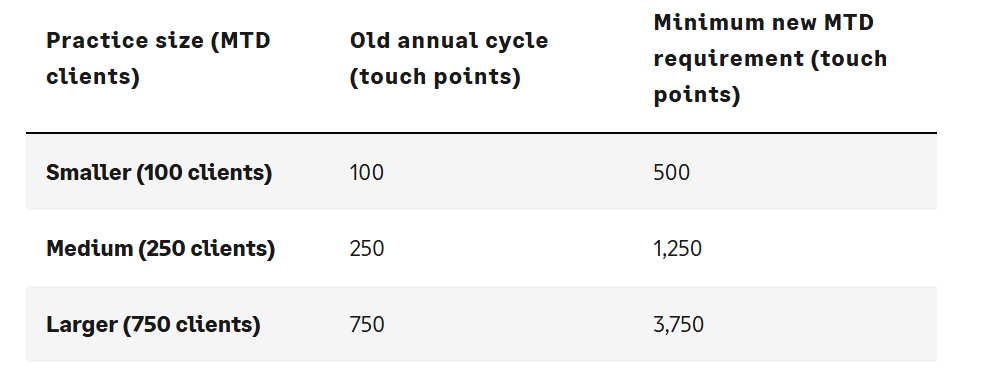
Here's a number that still catches people off guard: under MTD for Income Tax, each client now generates roughly five data gathering touch points a year, compared to the single annual Self Assessment cycle you're used to.
Multiply that across your client book and the picture becomes stark, especially for mid-larger-sized firms:
This is "more everything": more data cleansing, more client calls or emails and more chasing for missing paperwork.
If your team is already at 80% capacity, these numbers simply won't fit into a standard 37.5-hour week.
But the raw arithmetic is only part of it.
The real capacity drain comes from what sits underneath: the data cleansing that never quite stops, the client queries that spike every quarter, the education conversations with sole traders who are still confused about what's changing and why.
And then there's the emotional weight. As we've already explored here on Sage Advice, managing anxious or frustrated clients takes a toll that doesn't show up on any timesheet.
Most practices overestimate how much productive time their teams actually have.
Once you subtract CPD commitments, internal meetings, admin, sickness, holidays and the inevitable corridor conversations, a 37.5-hour week might deliver 25 to 28 genuinely billable hours – and that's being generous.
If you haven't mapped this out honestly, now is the time.
Practical step: Map your net capacity
List every team member. Subtract non-client hours – CPD, meetings, admin, breaks. What's left is your real capacity.
Then overlay your MTD client list against it. If the numbers don't add up, you need to act before the first quarterly deadline on 7 August, not after.
Rescoping your tech stack: The audit
If your current tech stack was built for "once-a-year" compliance, it will break under the weight of quarterly reporting.
To bridge the capacity gap, you must move from reactive tools to proactive agents.
Before the first deadline hits, run your current software through this four-step audit:
The chasing test: Does your software automatically identify missing records and nudge the client via WhatsApp, email or app notifications? If your team is still manually emailing clients for receipts four times a year, your tech has failed.
The cleansing test: Does the software use AI to flag anomalies or errors before you see them or are you still the one spotting the duplicates?
The interoperability test: Do your client's digital records flow seamlessly into your submission software without manual exports or "bridging" gymnastics?
The theatre check: Beware of "AI theatre" – tools that look impressive but just relocate the work from one screen to another.
If you're still spending hours reviewing, reformatting and correcting "automated" drafts, that tool isn't saving time; it's just changing the nature of your exhaustion.
MTD needs AI that removes work, not moves it
The goal for any modern practice is exception-led workflows.
This means technology – like the Sage MTD Agent – handles the routine, rules-based tasks automatically and only alerts a human when a professional judgement call is required.
What "exception-led" looks like in practice:
Automated segmentation: The AI identifies which clients are MTD-ready and which are lagging, then assigns tasks to your team.
Configurable control: You decide the level of automation. High-confidence tasks (like standard expense matching) happen in the background; ambiguous data is routed for your review.
Drafting and pre-submission: The agent pulls data, checks NI numbers and HMRC authorisations and drafts the quarterly report for a final "human-in-the-loop" sign-off.
The Sage MTD Agent: Exception-led AI in practice
This is where the Sage MTD Agent fits in – and it's worth understanding what it does differently.
The MTD Agent isn't a chatbot or a bolt-on feature. It's an agentic AI tool built into every Sage for Accountants plan that handles the end-to-end MTD workflow: preparation, quarterly updates and submissions.
Critically, it operates on the principle of configurable control.
You decide how far automation goes. High-confidence tasks are handled automatically; anything ambiguous gets routed for your review.
In practical terms, that looks like this:
Automated client segmentation: The agent identifies which clients are MTD-ready and which need preparation, then adds tasks to a shared list that can be assigned and set to recur.
Document chasing: If records are missing, the agent contacts clients via email, WhatsApp or in-app notification, with you choosing the tone and timing.
Quarterly submission reports: Data is pulled from digital records and drafted for your review before HMRC filing.
Error detection: The agent reviews submitted data, flags anomalies and can suggest or apply corrections.
Authorisation checks: Verifying NI numbers, business structures and HMRC agent authority before anything is submitted.
The key phrase here is "exception-led." The agent does the repeatable, rules-based work. You handle the exceptions, the judgement calls and the client relationships.
That's AI removing work, not moving it.
The next wave is coming: April 2027 and the £30,000 threshold
April 2026 is about the first cohort – sole traders and landlords with gross income above £50,000.
You're likely deep into working with them already. But the second wave deserves equal attention right now.
From April 2027, the threshold drops to £30,000.
That's a significant expansion of the client base that'll need MTD-compliant workflows and many of these clients will be less digitally mature, less accustomed to quarterly reporting and more reliant on you to guide them through the transition.
This means the coming year isn't just about servicing your current MTD clients. It's about identifying and preparing the next cohort.
The sooner you start those conversations, the smoother the transition will be.
Clients who discover they're in scope six weeks before a deadline are clients who will take up disproportionate amounts of your time in panic mode.
Action for the next 90 days
Segment your client list by income band.
Identify every client earning between £30,000 and £50,000.
Begin outreach now – explain what's coming, what they'll need to do differently and what it means for your working relationship.
Early education here saves crisis management later. And don't forget the £20,000 threshold arriving in April 2028 – start flagging those clients, too.
Behaviour change: Yours and your clients'
MTD requires new habits from everyone. For your clients, this means moving from an annual shoebox-of-receipts mindset to ongoing, real-time record-keeping.
That's a genuinely difficult behavioural shift for many sole traders and it won't happen just because HMRC says so.
It happens because you help them build the habit: setting up digital tools, showing them how receipt capture works on their phone via apps like AutoEntry, running through the first couple of quarterly cycles with them until it feels routine.
For your practice, the shift is equally significant.
You're moving from a model where much of the client relationship was concentrated into a few intense months approaching January, to one where contact is distributed throughout the year.
That changes how you schedule staff, how you manage workflows and how you think about client communication.
The practices that will handle this best are the ones that standardise relentlessly. Create a repeatable onboarding process for MTD clients.
Build templated communications for each quarterly touch point. Establish clear internal workflows so every team member knows exactly what happens at each stage of the cycle.
Building your 12-month action plan
Theory is fine. But you need a timeline. Here's a practical framework for the year ahead, whether you're a sole practitioner or managing a team.
Q2 2026: Stabilising the first wave
Complete onboarding for all clients above £50,000. Ensure digital recordkeeping is active, authorisations are in place and the first quarterly submission process has been tested.
Run a capacity audit. Map net hours against your MTD client load. Identify bottlenecks before they become crises.
Deploy AI where it counts. If you haven't already adopted the Sage MTD Agent or similar tools, now is the time. Don't wait for the workload to become unmanageable.
Q3–Q4 2026: Prepare the second wave
Begin outreach to clients earning between £30,000 and £50,000. Explain the April 2027 deadline. Help them set up digital recordkeeping now, so the transition is gradual rather than a scramble.
Review your first round of quarterly submissions. What worked? Where did time leak? Refine your processes based on real data, not assumptions.
Assess team well-being. The emotional labour of managing anxious clients is cumulative. Build in check-ins, spread high-intensity client relationships across the team and make sure no one person is absorbing a disproportionate share.
Q1 2027: Scale and optimise
The £30,000 cohort is now in scope. Your workflows, templates and AI tools should be tried and tested by this point, making onboarding faster and smoother than the first wave.
Look ahead to April 2028 and the planned £20,000 threshold. Start the identification and outreach cycle again.
Use the data you've gathered – from AI insights, quarterly cycles and client interactions – to evaluate which clients are genuinely profitable, which need repricing and where you can grow.
Final thoughts
It's easy to frame MTD as purely defensive: something you have to survive.
But practices that build the right operational foundations and adopt AI that genuinely saves time will find themselves with something unexpected – headroom and growth.
Headroom to take on new clients. Headroom to offer advisory services rather than just compliance. Headroom to invest in your team's development. Headroom to grow.
That's the real opportunity here.
MTD is forcing a modernisation that many practices would have needed to undertake anyway.
The firms that lean into it – with honest capacity planning, proactive client communication and AI that actually does what it promises – won't just keep up. They'll move ahead.
)