Loading profile data...

Loading profile data...

MEMBER STORIES

From three to 50 staff: How Potts’ Partnership is scaling UK manufacturing

From three to 50 staff: How Potts’ Partnership  is scaling UK manufacturing

Posted: Tue 21st Apr 2026

5 min read

We’re constantly told British manufacturing is a dying breed and small brands have no choice but to outsource production, often overseas. 

This week, we spoke to Ian Butt, the commercial director at the pioneering Potts’ Partnership, who manages a 50-strong manufacturing workforce at the Swindon-based firm.  

Founded in 2007 by Owen and Michelle Potts, Ian joined the firm nine years ago when the business had just three employees. Since Potts’ has been developing and manufacturing a diverse range of cooking sauces, condiments, marinades, dressings, gravies and stocks, made properly using authentic recipes, store cupboard ingredients with no artificial additives and often in small batches. 

What sets Potts' apart from most food businesses is its commitment to UK manufacturing when others have moved production overseas. 

Ian explained:

"We are a manufacturer slash NPD business. We love developing food, and we love making interesting food.

"What keeps us three in the business is the excitement of new products and making stuff." 

The company's journey from a small Marlborough warehouse to a purpose-built factory in Swindon illustrates the challenges and opportunities of scaling UK manufacturing. Moving from one production line to five running simultaneously, the business has been entirely self-funded "bootstrapped," as Ian puts it with no external investment. 

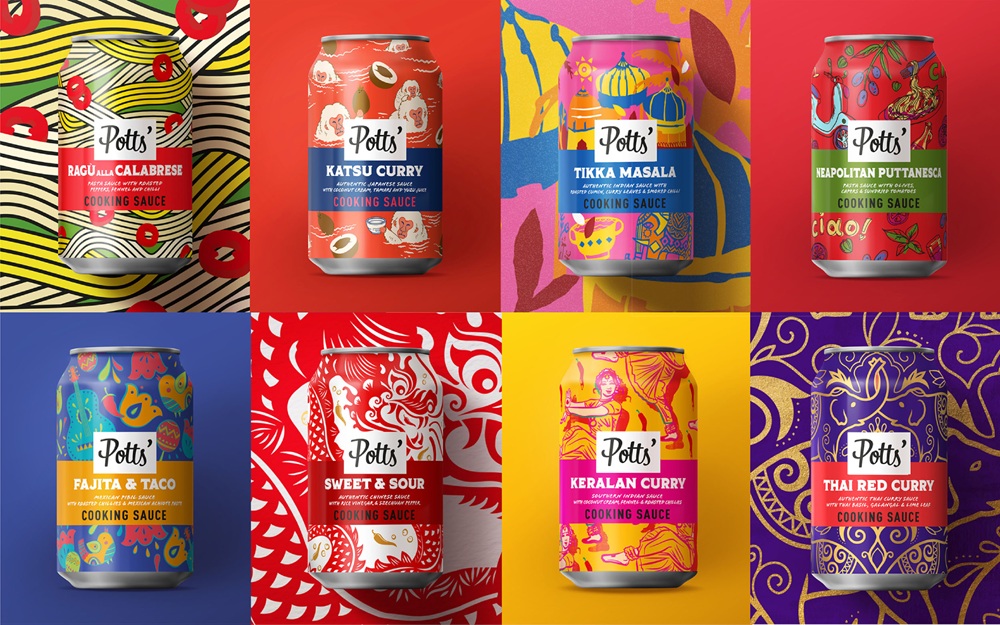
Potts’ Partnership cans

Innovation in packaging 

Potts' breakthrough came through pioneering sustainable packaging. Inspired by the craft beer industry's eye-catching aluminium cans, Ian and Owen recognised an opportunity to put liquid food products in recyclable cans instead of single-use plastic pouches. 

He said:

"It took us about a year to develop the technology to be able to put food in a beverage can. The technical challenges were significant, we developed 360-degree can ends to ensuring product stability without the high sugar content or gas usually needed to make the process work.” 

Ian says the innovation has removed approximately three million plastic pouches from the market annually, replacing them with infinitely recyclable aluminium packaging that boasts some of Europe's highest recycling rates. 

Global challenges, local solutions 

Despite its UK base, Potts’ faces the full force of global market volatility. Recent supply chain disruptions from the Suez Canal blockage to current Middle East tensions in the Straits of Hormuz have impacted packaging deliveries. Energy costs remain a persistent challenge, with prices "astronomical" compared to a decade ago. 

More frustrating are the regulatory barriers. Post-Brexit trade with the EU has become prohibitively complex, requiring veterinary inspections for products containing minimal meat content.

Ian said:

"I have to get a vet to come to my site to inspect cans of product... and we don't handle meat on our site at all." 

Export attempts to the US have faced similar hurdles, with two shipments turned back due to BSE-related restrictions on beef products, despite the minimal meat content.

Ian said:

"I’m trading with South Africa easier than I am trading with the Netherlands." 

Competing with giants 

As a small manufacturer, Potts’ faces unique pressures when negotiating with major retailers. While large corporations like Unilever can leverage commodity market positions, smaller businesses struggle with cost price increases. 

"If you're a firm like Unilever and you're almost plugged into the commodity market, it's different," Ian explained. "Whereas for us, we're so far down the chain... by the time the product gets to us, it can be considerably different to what maybe the retailers are looking at." 

When aluminium can prices nearly doubled, retailers questioned the increase by citing falling raw aluminium ore prices missing the complex supply chain between commodity markets and finished packaging. 

Sustainable growth 

Despite these challenges, Potts’ maintains its commitment to sustainability and UK manufacturing. The company operates at a 60-40 split between own-brand products and contract manufacturing for non-competing brands, providing economies of scale while supporting other UK food businesses. 

Ian said, highlighting the deficit in UK food manufacturing capacity:

"We find that we're contacted constantly by small brands that would like to find some manufacturing."

Looking ahead, Potts’ continues developing new packaging innovations, with another "world first" recyclable format in development. Its approach balances pragmatism with principles sustainability matters, but quality remains paramount. 

For Ian, the key to surviving as a UK manufacturer lies in innovation, flexibility, and accepting that "there's only so many things you can get to at once". While global pressures mount, Potts’ Partnership demonstrates that with the right approach, it is possible for British manufacturing to not only survive but thrive in challenging times.

People also read:

I am head of media at Enterprise Nation and have spent the past 12 years working with start-up and small businesses to help them build solid marketing and PR campaign strategies that really help them to grow. I have also worked with the national enterprise campaign StartUp Britain, the fintech investment platform provider Smart Pension and trade skills charity the HomeServe Foundation on media and policy. All of these were built from scratch and grew, with marketing and PR central to that expansion.

Get business support right to your inbox

Subscribe to our newsletter to receive business tips, learn about new funding programmes, join upcoming events, take e-learning courses, and more.

Start your business journey today

Take the first step to successfully starting and growing your business.

Join for free