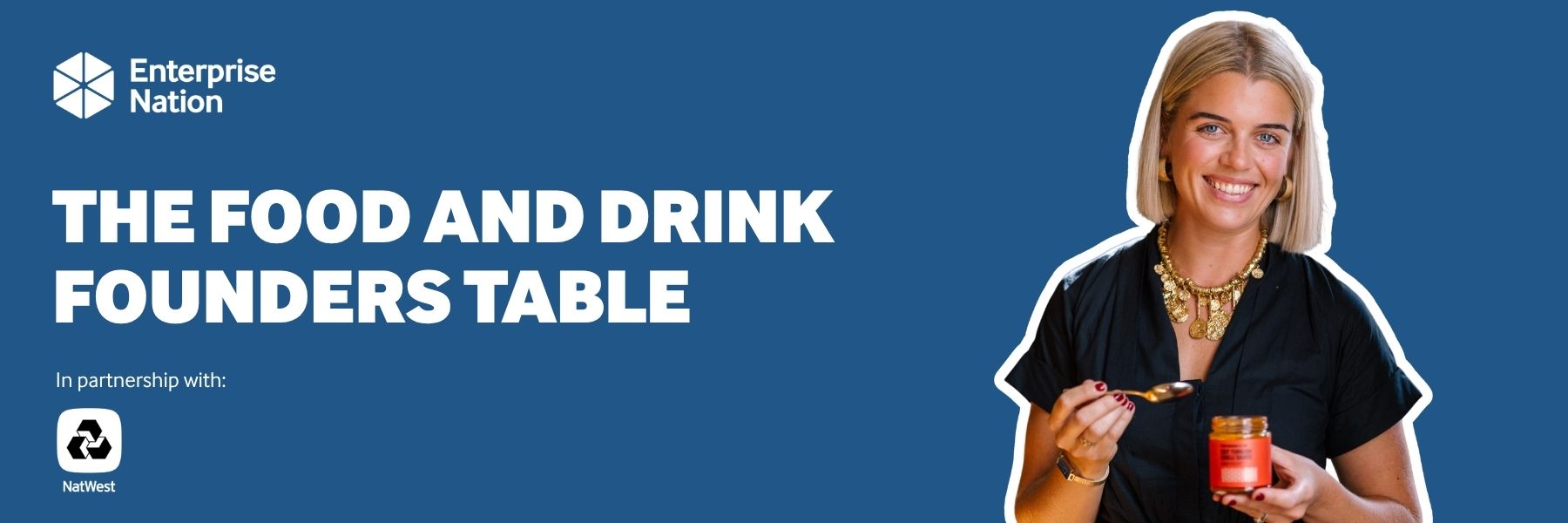
From kitchen table to one million ice pops: How Pola scaled up without losing its flavour
To view this video, please accept marketing cookies.
Posted: Mon 28th Sep 2026
11 min read
Isaac Greenway-Tambini started Nottingham-based real fruit ice pop brand Pola in 2019 with £500 and a set of hair straighteners.
Today, the business makes around 8,000 ice pops a day in summer and is preparing to move into its fourth production unit.
Pola makes ice pops using real fruit and 100% natural ingredients, all still handmade in Nottingham. Since launching, the brand has appeared on Dragons' Den, won multiple Great Taste Awards and sold more than one million ice pops.
At a recent Founders Table session, Isaac joined Leisa Pickles, ambassador for Enterprise Nation's food and drink founders hub, to share what it really took to scale from his parents' kitchen to a production facility.
He says:
“My dad's Italian, so food's always been close to my heart. And then I got interested in running my own business from quite a young age. So just the pairing of the two made sense.
“I didn't want to do another ice lolly on a stick or another tub of ice cream. So at the beginning, I just brainstormed how I could create a new exciting product.”
Starting small in the family kitchen
Straight out of university, Isaac moved back home and took over his parents' kitchen to test recipes and begin production. It started with five flavours and has since grown to about 20, across a core fruity range, winter immunity pops and cocktail pops.
The early process was, in his words, very hands-on.
“I was doing about five-litre batches. About 20 to 40 ice pops at a time," he recalls.
"I hung them on a wooden shelf and used a large syringe to fill the ice pops, and then we heat-sealed them with hair straighteners. So it was very hands-on. Not very efficient."
Running two to three batches a week, Isaac was making close to 100 ice pops a week. It didn't take long for the business to outgrow the space.
“The main struggle was running out of space," he continues.
"I got to a point where we're buying quite big freezers, and they just didn't work in my parents' kitchen. They were getting a bit annoyed. I was getting a bit frustrated.
“And then at the same time, we were getting larger retailers interested. So it was just a gut feeling that we needed to move.”
Making the first move
Isaac searched property sites for vacant units within a 20-minute drive and found a 300 square foot space on a local business park.
It took two to three months to sort the plumbing and electrics, and the move cost around £5,000 to £6,000, as he'd already bought much of the equipment.
His advice is to keep it simple and not buy machinery you don't need.
He also credits a strong relationship with his landlord, who helped with painting and even bought the unit's sink.
“I put a lot of effort into becoming friendly with our landlord, and we still got the same landlord now, and they still help us out a lot," he says.
"I just remember giving him loads of free ice pops, trying to make him a friend.”
The early stages of the business were funded largely through grants, including from universities and the King's Trust.
Isaac's little brother joined to help with production and local deliveries, and output grew to around 500 ice pops a week as Pola won listings with Whole Foods and Planet Organic.
The Dragons' Den effect
After two years in the first unit, Pola appeared on Dragons' Den. Isaac didn't secure investment, but the exposure transformed the business overnight.
He says:
“We basically got a year's worth of orders in 24 hours. It was aired in January.
"So I was in my small unit thinking, oh, it's January. It's freezing. People aren't gonna order ice pops in the middle of winter, but the complete opposite happened.”
Isaac calls it his biggest mistake. The team had made a few thousand ice pops ahead of the broadcast and ended up selling around 30 times that amount, leaving customers waiting up to three months for orders.
Pola moved to a 900-square-foot unit during this period, then to its current 2,500-square-foot space two years later.
The launch of a freeze-at-home range, which could be shipped ambient across the UK, was the other major driver of growth.
Scaling ingredients without losing quality
For many food and drink producers, the fear of compromising on taste can hold them back from scaling. Isaac shared how Pola's former strawberry flavour evolved over several years.
At first, the team drove to a local farm to buy wonky strawberries, then de-headed, washed and blended them by hand. As volumes grew, they switched to pre-de-headed whole strawberries and eventually to a ready-made purée, testing about 10 different options to find the right one.
Isaac acknowledges:
“At the start, you hold your recipes and core products really close to your heart. And I did too. And I would say it restricted us somewhat.
"We don't sell any of the same flavours that we did at the start.”
He believes that if a recipe can't scale, you either swap an ingredient, find a supplier who can do the labour-intensive work, or drop it.
That said, if you're happy staying small and selling at local markets, it's a completely different decision.
Isaac still develops every new flavour and taste tests every single batch. Pola uses a sign-up waiting list for limited-edition flavours, so the team can gauge demand before committing to production.
“I still taste test every single batch," he says.
"We obviously follow recipes, but that's something that I've struggled to outsource. I'm slowly stepping away from the production side just because I need to.”
Planning production for growth
Today, Pola has a team of six to eight people depending on the season. Isaac and Finley run production, Amber and Tara handle packing, and there's support in customer service and marketing.
Looking back, Isaac wishes he'd designed his production processes with growth in mind from day one:
“At the start, we used cheap machinery that was unreliable. I wasn't really thinking about how we're gonna make this work next year if we do keep growing.
“If we're using the same machinery and growing every year, it's just gonna produce bottlenecks down the line.”
The business is now preparing to move into a 4,500-square-foot unit ahead of next summer. The plan includes more production lines, doubled batch sizes, greater automation and a couple of new hires.
“I want to get us to a place where we're making more stock than we're selling, which sounds crazy, but it's a problem we have,” he notes.
Pola keeps picking, packing, customer service and marketing all under one roof. Isaac says it's simply easier, and he's heard more bad than good about third-party warehouses from other food founders.
Isaac's advice for food and drink founders
On environmental health inspections, Isaac says the key is documentation. When the officer visited his family home, she was more interested in his Safer food, better business (SFBB) pack and his freezer and pasteurisation temperature logs than examining the kitchen.
“I still stress about them to this day, but every time they arrive, I'm like, oh, why do I stress so much?” he laughs.
To find retail buyers, Isaac identifies the relevant category buyer by name, then uses tools such as RocketReach to work out the retailer's email format.
He also admits he got pricing wrong early on, listing in Whole Foods at too high an RRP, and wishes he'd found a mentor sooner.
When it comes to packaging, minimum order quantities can be a real barrier for small brands. Pola started with ready-made pouches it filled manually, before switching to reels formed on its own machinery.
“The more suppliers you message, the more likely you are to find someone that supplies a lower MOQ, " he advises.
“If you say, I know we're only ordering 200 this time, but I guarantee next year, we'll be ordering 10 times that amount. So really trying to bring them on the journey along with you helps.”
For founders preparing for a TV appearance, Isaac recommends contacting food and drink businesses that have featured on the same show before and averaging their sales figures.
And for those looking for funding, his advice is to keep checking with universities, local councils and organisations like the King's Trust every few months.
“There's always new programmes popping up. So the help is out there. It's just really about scouring the internet,” he says.
The October Table: Borough 22
For our October Table, we're going behind the scenes with Ryan Panchoo, founder of London-based inclusive treats brand Borough 22. Sign up now.
I’m the Founder and Chief Go Getter at Find me the Leads®, an independent sales consultancy helping food and drink producers get their products into farm shops, delis and garden centres.
Through our done-for-you outreach programmes, we connect brands directly with decision-makers — generating conversations, sample requests and real opportunities to get products onto shelves.
With over 25 years’ experience in sales, including time at Mars Incorporated, I set up Find me the Leads® in 2018 to give small businesses access to the kind of proactive sales support usually reserved for larger brands.
I was named Enterprise Nation Sales Adviser of the Year for the UK and Ireland in both 2022 and 2024 and I am the Leader for the Nottinghamshire Small Business Meet Ups.
I’m also the best-selling author of The Only Sales Person in the Room – 52 Ways for Small Business Owners to Master the Art of Selling, where I share practical, straight-talking advice to help business owners build confidence and take action in their sales.
Alongside my consultancy work, I share practical sales insight through mentoring, workshops and my podcast, helping founders take control of their own sales process with confidence.
When I’m not on the phone opening doors for clients, you’ll usually find me out walking my Miniature Schnauzer, Buddy or in an independent coffee shop with a flat white and a slice of coffee and walnut cake ☕