Do you understand your whole business – or just the part you're good at?
Posted: Mon 13th Jul 2026
7 min read
Most business leaders excel in their specific roles but struggle to see how all the pieces fit together, according to accountant and author Edward Rowe.
From his air-conditioned office in Abu Dhabi, Edward tells me he has developed a systematic approach for business founders and managers, which, if followed, he argues could help avoid mistakes, addressing what he calls "structural blind spots".
After 21 years working across global organisations and sovereign wealth funds, Edward noticed a recurring problem: capable professionals operating within businesses they were never taught to fully understand.
"Deep expertise develops in specific areas, not across the whole system," he says, who currently works for a sovereign wealth fund while developing The Standard Model for Business.
"Organisations are managed in parts rather than understood as a whole, creating structural blind spots."
These gaps, he argues, limit businesses at every level, from solo entrepreneurs constantly firefighting to established companies unable to identify why growth has plateaued.
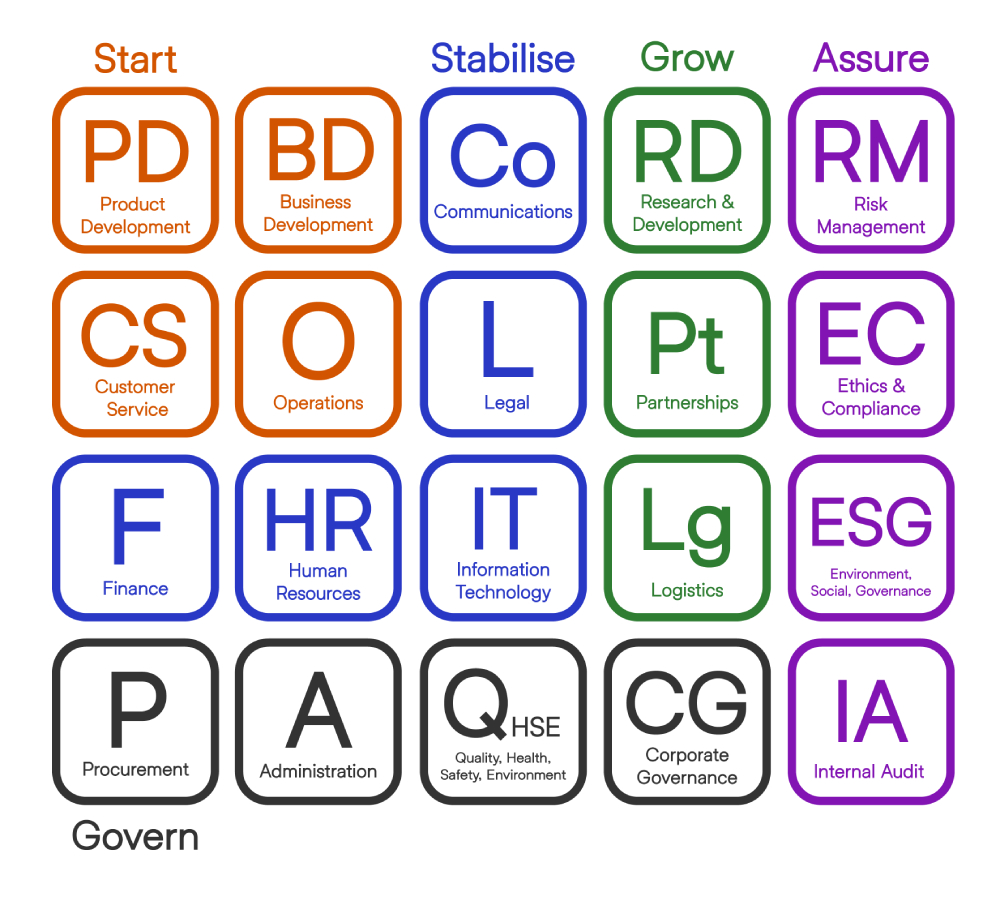
His response was to write The Standard Model for Business, a framework published by Rethink Press that maps organisational development across five stages: Start, Stabilise, Grow, Govern, and Assure.
Testing the framework in practice, Edward, a qualified accountant who has advised boards and executive teams globally, has lived in Abu Dhabi for 16 years.
His current project gives his framework real-world testing to prove that the theory works: he's using the model to build his own business – supporting businesses to grow according to his system.
"I'm right at the start, and I’m currently working on product development," he says. "The book is the entry product, and I'm building on it by offering a free assessment that benchmarks businesses against the model."
Planned future developments include training courses and consultancy moves that align with his framework's stabilisation and growth phases.
The four functions that make or break early-stage businesses for start-ups
Edward identifies four critical areas that must work simultaneously: product development (from ideation to launch), business development (sales, marketing, strategy), customer service (retention and lifetime value), and operations (reliable delivery).
The challenge is maintaining competence across all four.
He notes:
"I've seen start-ups with strong products but weak customer service; they struggle with complaints and can't grow. Others excel at sales and marketing but have subpar products – initial success followed by customer churn and revenue loss."
"The number of direct reports becomes really difficult at 12 to 13 people."
Beyond this threshold, team dynamics shift, he says.
"Small groups naturally form within the larger team. Those groups can drift over time because a single founder managing all these relationships can't keep up with everyone's needs."
The solution requires structural changes – hiring managers, building HR functions, and implementing formal IT systems. This marks entry into the Stabilise stage, where informal operations meet formal structure, and many founders discover they prefer building products to managing systems.
The lifestyle business decision
Edward's framework acknowledges that not every business should pursue maximum scale.
He says:
"It depends entirely on your ambitions as an owner. Many people run successful businesses that provide good income for their families. Most businesses operate at this level, and their owners are satisfied there."
For these entrepreneurs, mastering the Start stage suffices.
"You have your products, sales capability, customer care, and efficient operations. Many people are content with £100,000 to £500,000 revenue," he continues.
Only entrepreneurs targeting the top 10% (£1 million-plus revenue) need to consider the full framework. "That requires building finance functions, HR systems, and proper IT infrastructure.
For £10 million in revenue, the top 3-5% territory, the Growth stage becomes essential. That involves formalised R&D, strategic partnerships, investment in logistics and digital capabilities.
Scale as protection
Edward's upcoming book on personal finance and cost-of-living pressures reveals a structural challenge for small businesses during economic uncertainty.
"Economies of scale benefit large companies significantly," he explains. "Larger purchasers can negotiate better terms and resist price increases. Small businesses have no such leverage; suppliers essentially say 'take it or leave it.'"
This creates systematic disadvantages that effort alone cannot overcome. Larger companies can integrate vertically, controlling supply chains from source to customer.
"That capability really emerges at the Growth stage. It's not available to smaller businesses, but as companies grow, they can strengthen their position by integrating their supply chains," he continues.
Without scale, businesses remain price-takers rather than price-makers.
Where the framework fits for Enterprise Nation members assessing their position, Edward offers a free online assessment comparing businesses against his framework stages.
The model provides clarity rather than guarantees, showing which capabilities matter at each stage and which can wait. For the 90% of businesses operating under £1 million revenue, this perspective could help identify specific growth barriers and next steps, he believes.
As one reviewer says:
"Most leaders understand their function well but few grasp how the entire business operates. That gap causes significant organisational problems."
The Standard Model for Business aims to bridge that understanding, offering what Edward calls "the map nobody gave you", whether you're building a lifestyle business or targeting rapid scale.
I am head of media at Enterprise Nation and have spent the past 12 years working with start-up and small businesses to help them build solid marketing and PR campaign strategies that really help them to grow. I have also worked with the national enterprise campaign StartUp Britain, the fintech investment platform provider Smart Pension and trade skills charity the HomeServe Foundation on media and policy. All of these were built from scratch and grew, with marketing and PR central to that expansion.
)