Grow London Local: in conversation with Emma Jones CBE
)

Posted: Tue 2nd Dec 2025
Having started, grown and sold her own small business by the age of 27, Emma Jones has dedicated the last 20 years to supporting the UK's entrepreneurs – and is now one of the most recognisable figures championing our small business community.
In 2005, she founded Enterprise Nation, a dynamic digital support platform that reaches more than 800,000 businesses every year.
While leading Enterprise Nation, Emma presented a positive campaigning voice to government and the media on behalf of small businesses.
She also cofounded enterprise campaign StartUp Britain in 2011 and served a two-year term as SME Representative for Crown Commercial Service, working to encourage SMEs to sell to the public sector.
In June 2012, Emma was awarded an MBE for Services to Enterprise and in 2021 she was awarded the rank Commander of the Order of the British Empire (CBE).
And earlier this year, she was appointed Small Business Commissioner, to provide advice and support on issues relating to late payment and payment practices in the private sector.
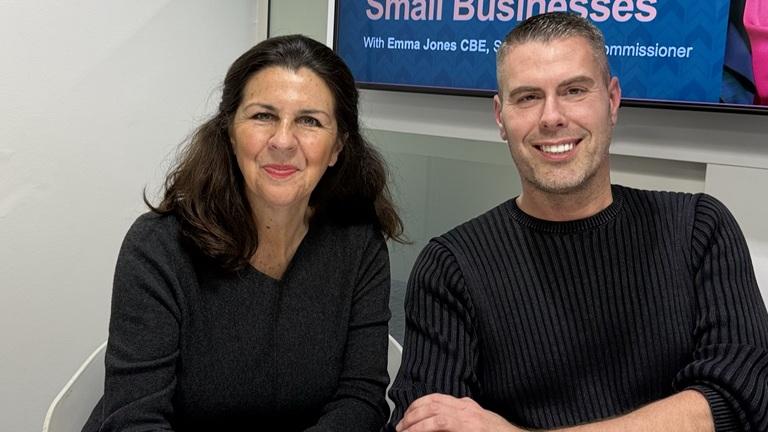
Dan Adair-Wright, Head of Business Support at Grow London Local, sat down with Emma to find out what support is available to help small businesses that have been impacted by poor payment practices.
Read the full interview below:
Can you tell us a bit about the Office of the Small Business Commissioner?
The Office of the Small Business Commissioner was established in 2017 with a remit that remains the same today: to make sure that small businesses get paid promptly!
We're what's called an arm's-length body – so we report into the Department for Business and Trade – but we're also slightly autonomous.
I've got a small and mighty team of 14 people, and we're on a mission to make life easier for small businesses by getting money moving through the economy, faster.
Let's start by looking at the impact that late payments can have on small businesses.
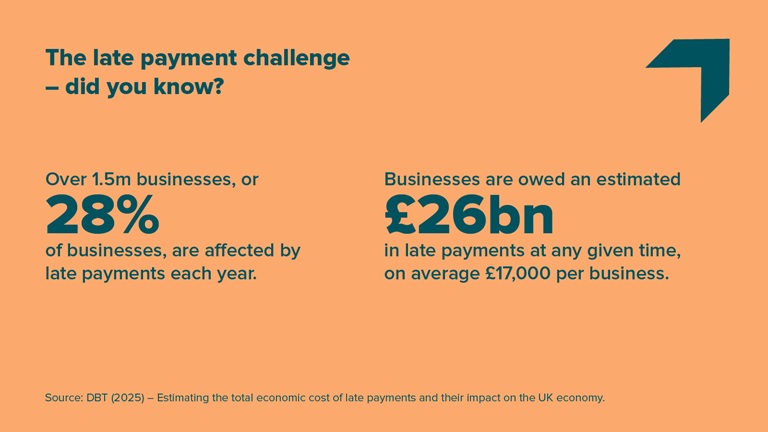
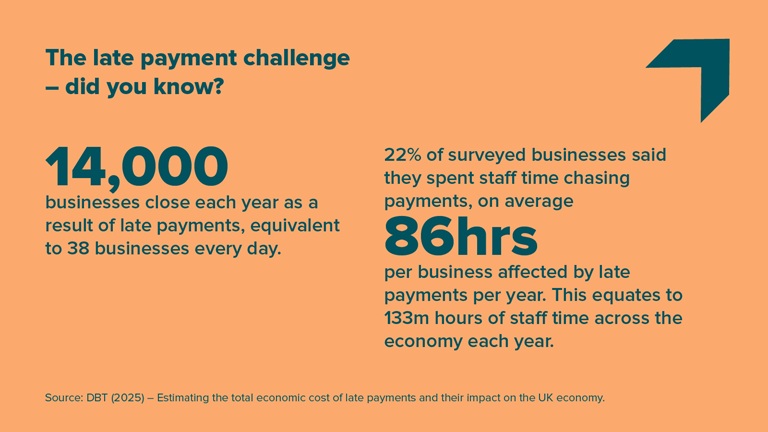
The impact is huge – and it doesn't just impact the business itself, it can affect the whole life of a business owner. One late payment can mean they're not able to pay their employees or even themselves.
Which could mean not being able to pay their mortgage or their child's school fees. It's not good for business, it's not good for a founder's mental health and, of course, it's damaging to the economy as a whole.
I've been a small business owner and have experienced first-hand what it's like to deliver a service and have to chase payment. It's just so demotivating – and not a productive way of spending your time.
Business owners want to get on with growing their business. That's challenging enough, without spending those non-productive hours chasing debt.
We want to free up their time, reduce that burden, remove the friction and unleash business owners so that they can get on with what they do best: hiring, exporting, innovating, growing, making sales.
What we're saying to larger businesses is, you'd never dream of paying your employees late, so why is it acceptable to pay your suppliers late?
We're trying desperately to encourage a positive payment culture, because it's simply the right thing to do.
This isn't a new problem. Has the problem got worse?
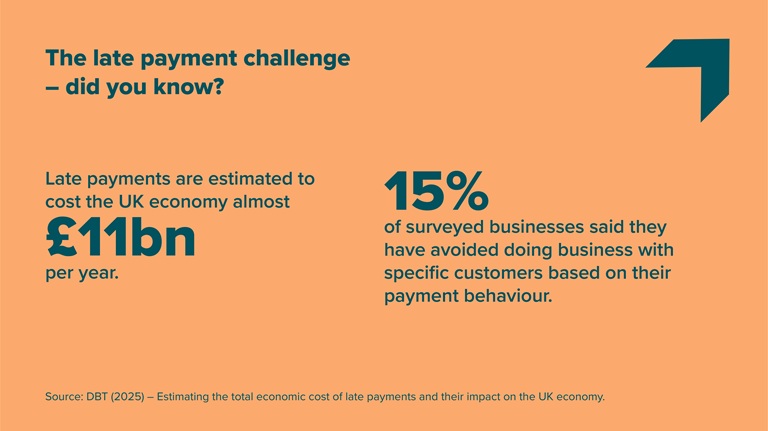
Yes, the problem has been longstanding. This is actually the first time the government has released statistics though, so we're using 2025 as our benchmark point.
The statistics will be measured again in two years' time, and I'd of course love to think that we'll see huge improvements.
In July, the government launched a payment consultation looking at potentially bringing in new legislation, which could see us move to 60-day maximum payment terms, with the view to reducing that even further to 45 days, over the next five years.
Currently, small businesses are feeling that they're having to sign contracts where the payment terms are 90 or 120 days, which is too much. This legislation would simply make it illegal to form a contract with terms longer than 60 days.
It would also remove the need for small businesses to check, and potentially challenge, the terms of the contract.
Those are difficult conversations to have, and it can cost a small business a lot of money to seek legal advice.
What's being done to tackle the issue?
We're looking at measures whereby a customer will only have 30 days to dispute an invoice. If it's not disputed within that window, it's assumed that the invoice is fine, and that it'll be paid on time.
We'll know more in early 2026 but, if the measures are introduced, any organisations that breach those terms would be penalised.
This will really strengthen the powers of the Small Business Commissioner and send a clear signal to larger organisations that they have to pay on time.
For small businesses looking to trade with other small businesses, we're also looking at how we can aggregate all the incredible data collected by the likes of Experian, Xero, Sage and Intuit to come up with a prompt payment "score".
It'd make it easier to identify prompt payers, and they can use it to make a decision on whether they want to trade with them. I'd love to see these initiatives in place, to really get that money flowing quicker.
What advice would you give small businesses before entering into a contract with a larger organisation?
I've been there myself. You win a big contract. And you're so excited to have won it that you almost don't even read it, you just sign!
But it's so important that you go in to these relationships in a position of strength.
Read the contract.
Be aware of payment terms and conditions.
Know your rights when it comes to the interest that you can charge when an invoice becomes overdue.
Understand the offer of the Small Business Commissioner and its role in enacting these terms and conditions.
Are there common pitfalls that small firms need to avoid when signing a procurement contract?
It's really important that small businesses get their invoicing right.
We do see cases where a late payment is due to mistakes the small business has made. So be sure to send it to the right place or person – and follow up to make sure they've received it.
A small business might also want to consider the services of a bookkeeper or accountant. They're amazing people in terms of credit control, helping small businesses understand:
when they should have been paid
when to chase
how often to chase
what action to take if you're just not getting paid
And of course, cloud accounting software can also help in speeding up payments. Some even give users access to an AI agent that will chase overdue payments for you.
This not only means that the small business owner doesn't need to waste time chasing for themselves, but it also helps maintain relationships with customers, as the chasing is being done on your behalf.
This brings us perfectly onto my next question, which is around the relationship between digital adoption and late payments. What can you tell us about that?
It's a big topic right now: how do we use digital technologies to enable faster payments?
Another thing that the government is currently considering is e-invoicing, as there's a lot of research to prove that, in countries that have adopted e-invoicing, payments move quicker.
Essentially, this means an automated digital exchange of invoice information directly between a buyer's and a supplier's financial systems. It absolutely creates less mistakes in the system.
So Making Tax Digital is likely to expand, moving beyond voluntary adoption and forcing small businesses to digitally report.
We've also recently worked with eBay, Temu, Stripe and PayPal, to make sure small firms trading digitally on those platforms get paid more quickly.
Before escalating the issue to your team, what steps can a small business take to recover money?
As soon as something becomes overdue, reach out to your first point of contact in the organisation.
We see many instances where a small business has tried multiple times to get paid without success, only to find that there's a very simple explanation, such as a change in systems or processes, or even a miscommunication.
It's not that the customer doesn't want to pay, it's that something's fallen down.
Of course, if you're still not able to resolve the matter, you can then send one final email to let them know that you're about to contact the Office of the Small Business Commissioner.
What support can you offer, which businesses are eligible and how do they access it?
So, we've got a very clear remit.
We support businesses with fewer than 50 employees that have an issue with a business with more than 50 employees, operating in the private sector. Our service is impartial, and completely free of charge.
We don't cover the construction industry, but there's another organisation that does.
When they reach out, they're assigned a casework manager who will take time to understand the problem and then pick it up with the large company on their behalf.
The casework manager's role is to get the money back while keeping the client relationship intact.
So far, we've managed to recoup almost £10 million of unpaid invoices, which is a fantastic achievement.
Right now, we're working hard to raise awareness of the support that we offer, so we have a growing number of cases at the moment.
But of course, the goal is to reduce the number of cases coming in, because that means that everybody's getting paid.
What are some of the instances where there's no resolution? What if the organisations simply can't pay?
Sadly, the cases that can't be resolved are those where insolvency is involved.
While it tends to happen less to larger companies, there are instances where not being able to get the money paid is simply due to one of the parties no longer existing, and the funds just aren't available.
Let's look at some of the good news stories now. What can you tell me about the Fair Payment Code?
I'm a big believer in showcasing those who are doing it right, because hopefully their peers will follow. And the biggest instrument we've got for this is the Fair Payment Code.
Launched in December 2024, it's a tiered system of awards – bronze, silver and gold – aimed at improving payment performance.
Gold-level awardees pay 95% of their invoices within 30 days – and obviously we'd love every large company to be doing that.
We've already signed up some amazing companies, including NatWest and AstraZeneca, and we're actively approaching companies whose payment data shows that they'd likely be awarded gold.
On the flipside, we're also sending out slightly less happy letters to those who aren't delivering good payment performance to encourage them to get their houses in order.
The application process is pretty rigorous. You have to give references from clients, and we review awardees every two years to check that they're still doing a good job.
But it's free to apply and it's open to businesses of all sizes. In fact, just last week I visited a brilliant butcher's shop in Peckham called Flock & Herd.
They've recently been awarded gold and they're delighted. They use it in their communications with customers.
You've been in this role since June. What does success look like for you over the next two years?
I love this question because I'm very driven by what success looks like.
Mission-wise, we want to make life easy for small businesses. How we do that is by getting money moving quicker through the economy, and reducing the number of hours spent chasing overdue payments.
We're operating in a challenging economic environment, but in two years I want to ask small businesses: does it feel slightly easier?
Do you know your rights when it comes to terms and conditions? Have you seen better payment terms in the contracts?
Are you finding that large corporates are now paying you on time? Are you using digital technology, and do you feel that it's picking up some of the slack for you?
For the last 30 years you've been championing entrepreneurialism. Where does this passion stem from?
I blame my mum! She was always entrepreneurial and ran her own business. And so, I saw first-hand how it benefited us as a family.
She had flexibility to spend time with us. We understood when things were going well and not so well.
It was after I sold my own first business, and I was figuring out what to do next, that I read a book called Free Agent Nation by Dan Pink.
It spoke about the number of people starting businesses in America, and questioned what support was available for all these brilliant self-employed entrepreneurs.
I had a bit of a eureka moment. I felt sure that the same thing was going to happen in the UK and that we too would become a nation of entrepreneurs. Enterprise Nation was formed.
What still inspires and drives me today is hearing all the stories of these amazing entrepreneurs. I recently facilitated what I called an "SME Safari", where I took policymakers from the Department for Business and Trade to meet real-life entrepreneurs.
No matter how long I've been doing this for, I never cease to be amazed by these individuals. They're resilient, they take risks, they identify opportunities, they hire teams and they keep going! They also keep our economy going.
All I can do is try and make their lives a bit easier, and to help create the infrastructure that allows them to flourish – because that's what we need them to do.
Now to our quickfire questions...
If you were going to start another small business, what would it be?
A bookshop.
I know you love to read. What are you reading at the moment?
I'm currently reading a book by a gentleman who's no longer with us called Lord Young. It's called The Enterprise Years.
What are your top three tips for someone starting out in business?
Write a plan, make your first sale, build a home on the web.
Which entrepreneur, dead or alive, would you like to have dinner with?
There are so many entrepreneurs I'd like to have dinner with… I think I'll go for Elon Musk.
If the Small Business Commissioner was a superhero, what would her superpower be?
Her superpower would be to reduce the number of hours spent chasing debt.
And then finally, what's your favourite London-based small business?
Oh, that's a really hard question. I've got a few but can I offer two?
Change Please is an amazing business tackling homelessness through coffee. And Emilia's Crafted Pasta, I met the owner earlier this week and he's just incredible.
Book a free consultation with a Business Support Manager
Need help finding support for your business? Our Business Support Managers are here to help. Fill in a short form and we'll get back to you within two working days. Arrange your consultation now
Get business support right to your inbox
Subscribe to our newsletter to receive business tips, learn about new funding programmes, join upcoming events, take e-learning courses, and more.
Start your business journey today
Take the first step to successfully starting and growing your business.
Join for free