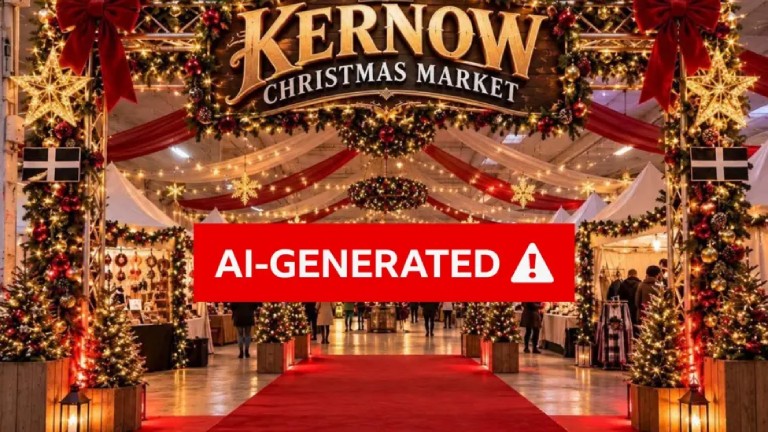
When your AI promo picture meets reality: A lesson for small businesses
Posted: Fri 27th Nov 2026
5 min read
A Christmas market in Cornwall was promoted with AI pictures of a hall packed with stalls, fairy lights and garlands.
Visitors found about five stalls, no decorations and buckets catching water from a leaking roof. One stallholder, who'd paid £180 for a pitch, said there was nothing to suggest a market was even on.
The man who produced the images said they were "so easy to do". He's right. That's the problem.
The market has since been cancelled and the bookings refunded. More than 700 people commented on the BBC's story, and most of the argument was about AI.
We've been here before. In 2024, families paid £35 a ticket for "Willy's Chocolate Experience" in Glasgow after AI pictures promised chocolate fountains and oversized sweets. The police were called and the tickets were refunded.
I reckon we're all arguing about the wrong thing:
AI made the promise free. It didn't make the delivery free.
So before you publish an AI image of something that doesn't exist yet, picture the side-by-side: your image next to a phone photo of the real thing on the day.
It's not really about the AI
Read the comments and you'll find two camps. One says this is plain old false advertising, which was around long before AI. The other says anyone who uses AI images should be avoided altogether. Frankly, I'm somewhere in the middle.
For a small business, AI is brilliant. You can show an idea you could never afford to commission.
One commenter put it well:
"Mock it up by all means, then check it can actually be done, down to the dimensions and the cost."
If you're showing something that doesn't exist yet, you need to be able to deliver it. Otherwise you're over-promising, and you find out in public.
The picture is free. The room isn't
I've spent 28 years in TV, so I know what it takes to dress a space. Even the background of a chat show or game show takes half a day in the studio.
On Channel 5's NFL show, we spent at least half a day moving team shirts and American football memorabilia around behind the presenters until it looked right. That was just the backdrop.
A winter wonderland is building a whole world. Wooden sheds, festoon lights, fir garlands. Easy to picture, hard to make. You're looking at two or three days at least, plus proper design.
I don't know what went on behind the scenes in Cornwall. The company says it advertised the event and booked the stalls, and that the venue was meant to sort the signage and decorating.
Fair enough. But whoever's job it was, the pictures were a promise, and somebody needed to check it could be kept.
What doing it properly looks like
I recently made a 25-second commercial for a whiskey brand that doesn't exist yet. It was never going to be broadcast or shown to the public. It was for an internal brand reveal, to inspire the team in India who'll create the packaging and labels.
The AI had real material to work from: renders and wireframes of the bottle, plus the label designs, all supplied by the brand design agency I was working for. Even so, it took tens of iterations. The labels, colours, lettering and little bottle details the agency had agonised over kept drifting. It's not a magic button.
Give AI no limits and it makes things up. Constraints keep the picture tied to the product you'll actually deliver. And everyone watching knew it was a concept.
That's the line for me. Show a concept to people who know it's a concept and it's a mood board. Use it to take money off people and it's a promise.
The side-by-side test
Before you publish an image or video of something that doesn't exist yet, ask yourself:
Can I deliver what this shows, in this space, by the date? Be honest about the time, the people and the budget
Does the viewer know it's a concept? A simple label such as "concept image" is enough
Have I given the AI real things to work from, such as dimensions, photos of the actual room or the real product, or have I let it invent?
What will the side-by-side look like on the day? If it would make you wince, change the picture or the plan
This goes well beyond markets. A caterer showing a spread they can't yet afford to stock, a salon showing a refit that hasn't been built, a builder's kitchen render with materials that aren't in the quote. Same trap.
What the gap says about you
People read the gap between the promise and the day as a message about how you work. An empty hall with a few gazebos, no signage and no cohesive look says something about your attention to detail and your follow-through.
If you're in events, that can undo years of credibility.
Want people to trust what you're promising? Show them something real too. A 30-second phone video of the actual space, as it stands today, costs nothing and sets honest expectations.
I help expert-led businesses turn what they know into clear, credible video that builds trust and drives action. Most of my clients are already good at what they do. The problem is that their expertise isn't always visible online.
They know they should be using video, but they're unsure what to say, what to make, whether to do it themselves — or how video connects to actual business results.
That's where I come in.
I've spent 28+ years working in UK broadcast television and live production, with credits including BBC, ITV, Channel 4, NBC and Netflix, The Piano, major royal events, concerts and live shows.
Today I bring that broadcast experience into businesses where expertise and trust drive the buying decision.
How I help
Video Strategy
Work out who you're trying to reach, which questions you need to answer and what each video actually needs to achieve — before worrying about cameras.
Messaging & On-Camera Direction
Turn complex expertise into clear, watchable video without sounding scripted, corporate or like somebody pretending to be an influencer.
Training & Implementation
Learn to plan, film, edit and publish credible business video using practical workflows your team can actually sustain.
In-House Video Systems
Build the strategy, scripting, filming and post-production capability to create useful video consistently without outsourcing everything.
Senior-Led Production
For higher-stakes projects, I build the production team around the job from a trusted network of broadcast professionals I've worked with over 28 years.
A few results
£300,000 contract from a £15,000 production
A case-study film created for Pabulum helped support a successful £300,000 pitch on its first use.
Around £3,000/month in additional course bookings
Helped Inspired Cosmetic Training build an in-house video system producing 3–4 course bookings a month from organic video.
DO Lectures: more from the content they already had
Repositioned and optimised 40 existing YouTube videos without filming anything new. Algorithm impressions increased 106% and daily views rose 74%.
40M+ YouTube views
Broadcast and concert projects I've worked on have generated tens of millions of views, including major arena productions.
From around 200 to 700–1,000 impressions
Helped an FSB client develop a simple weekly video workflow taking roughly an hour a week and substantially increasing her LinkedIn visibility.
My approach
I don't believe businesses need to become content factories. The fanciest video doesn't automatically win. The job is to make the message clear, make the video credible and give it something useful to do.
Sometimes that means learning to make better video yourself.
Sometimes it means building a repeatable system inside your business.
Sometimes the film matters enough that you hand the whole production over.
Not sure where to start?
My free Video Unlocked mini-course is a practical introduction to getting comfortable on camera and creating your first simple business video: https://bit.ly/Video_Unlocked
Or visit: https://mpvideoproduction.co.uk/
Expertise
Video Strategy • Business Video • Video Production • Video Training • On-Camera Coaching • Messaging & Scripting • YouTube • AI-Assisted Video • In-House Video Systems • Content Strategy