Inside No.10 North: Why small businesses are the engine of British growth
Posted: Thu 24th Sep 2026
10 min read
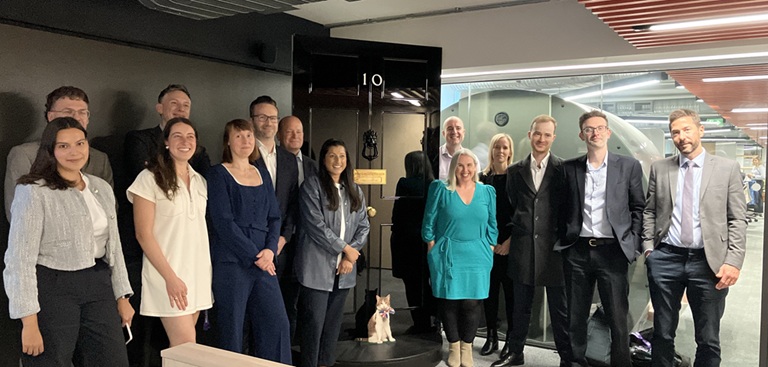
On an autumn morning in Manchester, Enterprise Nation was invited to No.10 North, along with nine other business representative organisations, for a roundtable on Good Growth and how government and business can work in partnership.
It was a front-row seat to a constitutional experiment that could reshape how the UK's 5.7 million small businesses, which account for 60% of private sector employment and £2.8 trillion in turnover, are supported.
The invitation to visit what Prime Minister Andy Burnham calls "the nerve centre for a rewired Britain" gave me a clearer picture of how government plans to deliver growth across the country, and where small businesses fit into it.
We then visited Sister, Manchester's Innovation District.
What is No.10 North?
No.10 North is an extension of the Prime Minister's Office, and from the moment I arrived at Heron House, where No.10 North has operated since July, there was a different energy to 10 Downing Street.
The common word across departments was community and collaboration. It's definitely an optimistic sense, and certainly the right mix to get this right.
It exists to move decision-making out of Westminster and closer to the places it affects. Director General Sam Lister leads it, and it hosts the revived National Economic Council, which brings ministers and regional mayors around the same table.
Its core focus is reindustrialisation, regenerating towns that have been left behind, and working with places on what they need.
The day
The day was organised by the Department for Business, Innovation, Science and Trade (BIST) with No.10 North. Around the table were BCC, CBI, FSB, IoD, Make UK, techUK, Startup Coalition, Small Business Britain, Family Business UK and Enterprise Nation.
We discussed two big questions:
How can every place build the partnerships and institutions it needs to grow?
What does good, place-based engagement between government and business look like?
Learning from Britain's fastest-growing city-region
Now, Director General Sam Lister and his team want to replicate that model across Britain.
The city-region's 10-year strategy, unveiled by the PM in July 2025, aims to deliver "the best decade since the Victorian era".
It combines sector-specific growth plans, integrated transport through the Bee Network, housing-first regeneration, and a 45-day work placement guarantee for every young person who needs one.
James Carroll, the Prime Minister's Special Adviser on Business Relations, described the approach as "a new model of government". Places identify their needs. No.10 North convenes the right people. Decisions happen faster, made by those who can act on them.
It sounds simple. But as I listened, I kept thinking about the layer below, the one that matters most to the businesses we support at Enterprise Nation.
No.10 North wants mayoral authorities across the country to take a similar approach to Manchester. That means picking their sector strengths, setting a small number of clear priorities, and delivering them with government as a partner rather than an approver.
The team talked about a short list of asks for each mayor and a delivery plan to build the capability places need, including civil service talent.
What the Prime Minister has said about priorities for the North
To understand the room, it helps to know the wider agenda. In his June speech, the PM set out a mission of "good growth in every postcode and hope in every heart".
The key strands are:
Devolution: "The days of Whitehall fighting the devolution of power into the regions and nations are over, for good."
Reindustrialisation: Supporting every region to set "clear and credible industrial ambitions" and giving it the support to achieve them
Towns: Places "no longer forgotten or written-off", supported to make the most of their assets
Young people: A work placement for every young person who wants one, and parity between technical and academic routes
Housing: The biggest council house building programme since the post-war period
The Greater Manchester model is ambitious and has a track record. The real test, as organisations like Centre for Cities have noted, is whether it can scale to places with different starting points.
Five things that stayed with me
1. Good growth has to reach every postcode
Ambition alone won't close the gap between Manchester and Middlesbrough, or between the centre and the suburbs.
In some areas, NEET rates (young people not in education, employment or training) are three times higher than elsewhere, a disparity that has sharpened since the pandemic.
Headline figures aren't enough. The question in the room was how investment reaches more places, and how people in those places can see and feel the difference.
This is where small businesses become central, not peripheral, to the growth agenda. At the start of 2025, the UK had 5.64 million small businesses (0 to 49 employees), representing 99.2% of all firms. They employ 13.1 million people and generate £1.9 trillion in turnover.
2. SMEs cut across everything
Skills, investment, housing, transport and innovation all come back to small firms. That's why co-designing support with business matters so much, and why I was pleased to be in the room to make that case.
3. Young people need routes in
The discussion at No.10 North kept returning to young people. The government announced a national work experience programme on 24 September, but there's another route that's often overlooked: starting a business.
4. Small businesses seed local economies
Growth doesn't only come from big investments. It also comes from growing the small businesses already in a place and backing the founders, especially those who face extra hurdles.
I made this point at the roundtable, and I was encouraged by the response.
Caroline Simpson, the Prime Minister's Deputy Chief of Staff, and Harriet Gordon from the new Good Growth Unit were both present, signalling Whitehall's commitment to getting this right. AI start-ups and tech are a growing part of that.
5. Joined-up government makes a difference
What struck me most throughout the day was the coordination between No.10 North, Downing Street and the Department for Business, Innovation, Science and Trade.
The teams share data and work as one team. It's what business has been asking for, and it was good to see it in practice.
Whether that collaboration survives contact with the reality of delivering growth in places with less infrastructure, weaker networks and thinner institutional capacity than Greater Manchester remains the test.
Academic analysts have noted that Manchester's growth has been concentrated in the urban core, with weaker income growth and high housing costs posing significant challenges.
Why this matters to Enterprise Nation
At the roundtable, I talked about Enterprise Nation's work on good growth in every postcode. Our view is that growth reaches every place when small businesses in every community get support locally.
That's the "layer below" the No.10 North team spoke about: local, community-level support for the businesses that make up most of our economy.
Through our network of small businesses, advisers and partners, we already work at that level. We're keen to help mayoral authorities and No.10 North turn priorities into practical support on the ground.
Seeing it in practice
The afternoon visit to Sister, Manchester's Innovation District, drove the point home.
In the Renold Building, a former engineering works transformed into a workspace for tech start-ups and university spin-outs, local business leaders spoke of collaboration between universities, private firms and public bodies. It was the Greater Manchester model in microcosm.
It was a fitting end, and a good example of what happens when a place backs its own strengths and brings business, universities and government together.
As the Chief Operating Officer at Enterprise Nation, the UK's largest small business community, we lead the charge in creating a dynamic two-sided marketplace that seamlessly connects small businesses with the support they need to thrive.
My passion for design, technology, and innovation drives our mission to revolutionise the business support landscape, making it more accessible, efficient, and impactful for entrepreneurs at every stage of their journey.
Every day, our team is dedicated to empowering start-ups and small businesses by providing timely and tailored resources that foster growth and success. We believe in the power of community and the importance of delivering the right support at the right moment.
I’m always eager to discuss how we can further enhance the Enterprise Nation platform and better serve the small business community. If you have any questions or ideas on how we can support your business, please don’t hesitate to reach out. Let’s work together to help small businesses succeed.
When I'm not building a marketplace I'm also the founder of Girls in movement, a not for profit that educates young girls in India - we have recently hit over 20,000 downloads on the podcast and launched an online store this year.
I've also just launched a Children's book called The Girl and Her Globe, so feel free to take a look: www.girlsinmovement.com
)