No.10's new faith roundtable series begins with Sikh business leaders
Posted: Fri 4th Sep 2026
12 min read
A few weeks ago, I was offered the chance to do something I'd wanted to do for a long time: bring my community to the table at 10 Downing Street.
My first thought wasn't really about policy, or process, or any of the things you'd expect. It was simpler than that.
I wanted to bring my community with me, and not just the people who look like the "obvious" choices for a business roundtable. I wanted a real mix: creatives, entrepreneurs, high street business owners, online and product businesses, media voices, humanitarians.
People who might not usually be in the same room together, let alone at the same table as government.
I did that deliberately. In my experience, our work in business rarely sits apart from our culture, our faith, or our communities; it's woven through all of it.
I've spoken about this before: you can't really understand Sikh entrepreneurship without understanding the community it comes from, and you can't understand the community without seeing the businesses, the creativity, and the service that come out of it.
On Tuesday, 1 September, that mix of people sat down together in the State Dining Room at 10 Downing Street for the first in a new series of roundtables No.10 has asked me to host, bringing faith communities and their business, creative and community leaders directly into government.
We were joined by Yasmeen Sebbana, the Prime Minister's Special Adviser for Faith and Communities, and James Carroll, the PM's Business Adviser, standing in for Lord Leong, the Minister for Small Business, who sent his apologies. Paul Dreschler attended on behalf of the government as the Lead NED.
Between them, this group represents millions of people, and some of the strongest credentials in the Sikh community today, spanning business, media, faith and social impact.
We had one hour. I wanted the conversation to be solution-driven from the outset, not a space to raise problems without direction, but a genuine working session, with people bringing ideas, data and asks that government could actually act on.
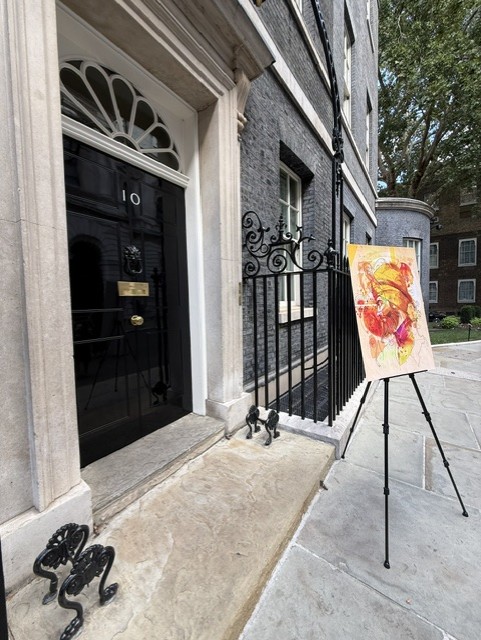
Before we opened the floor properly, Ink introduced a piece of his own artwork in the room, and used it as our way into the first topic, a reminder that the conversation ahead was as much about culture and identity as it was about business.
What we talked about
We covered three areas:
the reality on the ground, including how anti-Sikh hostility and safety concerns are being felt within the business community specifically, alongside other pressing issues like workplace discrimination
the scale of Sikh contribution to the UK economy and public life, and what's already working that could be scaled further
how to bridge the gap between a community that largely organises gurdwara by gurdwara and a government that needs consistent ways to engage with it
Voices from the room
Simmy Dhillon, co-founder of Simmer Eats and named among The Times 100 Businesses to Watch, spoke about the power of visible role models:
"Growing up, I didn't really see people who looked like me building businesses, particularly coming from a working-class Sikh background. I think one of the most powerful things we can do is give young people more positive, relatable examples of what's possible.
"Government can play an important role by giving these stories a platform and credibility, particularly for young people from working-class and ethnic minority backgrounds who might not otherwise see entrepreneurship as an option."
Amrit Bahia, who has spent 35 years in banking and is founder of The Student Career Compass and inaugural chair of the NatWest Sikh Network, brought data as well as personal experience to the table:
"It was a real privilege to have a seat at the table to represent the Sikh community. Opportunities like these are invaluable and key to sharing ideas and insights directly to policymakers.
"Two things I care deeply about are access to finance for ethnic minority businesses and giving young people the skills and confidence to succeed."
Through The Student Career Compass, which he founded to build the soft skills and confidence young people need through CV clinics, mock interviews and employer engagement, he's already delivered over 60,000 student-employer touchpoints.
That funding gap was echoed from another angle by Amardeep Parmar, co-founder of The BAE HQ, the UK's start-up ecosystem for Asian-heritage founders.
Since launching in October 2022, BAE HQ has supported over 15,000 event attendees and over 250 mentors, and alumni of its programmes have gone on to raise more than £20 million, with guests on its Startups Inside Out podcast collectively raising over £4 billion.
The organisation also publishes the annual State of Asian Funding Report, launched in Parliament each year, the first dataset of its kind in the UK tracking how much VC funding actually reaches Asian entrepreneurs.
It's exactly the kind of hard evidence base that turns a conversation about access to finance into something government can act on.
Jaspreet Kaur, the award-winning poet, writer and educator, spoke about moving the conversation from crisis response to genuine, ongoing partnership:
"Bringing together Sikh leaders from different sectors and experiences matters because our community is not a single voice, and the challenges we face cannot be understood through a single lens.
"What felt particularly significant was the opportunity to move beyond simply identifying problems and towards practical solutions, from tackling anti-Sikh hostility and improving understanding in schools, to recognising the enormous cultural, social and economic contribution Sikhs continue to make across Britain.
"For me, this kind of engagement should not only happen in moments of crisis. Building an ongoing relationship between government and the breadth of the Sikh community is vital, so that Sikh voices are heard not only when something has gone wrong, but as part of shaping the future of public life in this country."
Amrit Singh Mann of Sky News reflected on what needs to happen next:
"I was really impressed by the range of individuals brought together from different industries. Collectively, we raised a number of issues that are important to the Sikh community and us.
"I believe dialogue with government is always important, but it is only meaningful if it leads to action. I hope this meeting is the beginning of some much-needed positive change."
These aren't small numbers, and they don't happen by accident. Culture and community are a huge part of that story: the values of hard work, service and looking out for one another that so many of us grew up with.
Why representation matters to me
Representation came up again and again in the room, and it's something close to my heart. I run my own not-for-profit, and I wrote a children's book, both for the same reason: growing up, I never saw people who looked like me on TV, in books, or in sport.
What I did see was my family, and families like mine, building incredible businesses across the UK, often quietly, without much recognition beyond their own communities.
That's changed since then, but not as much as it should have. Ethnic minority representation on FTSE 100 boards reached a record 20% last year, and there are now more ethnic minority CEOs leading FTSE 100 companies than ever before, but senior management representation still sits at around 11%.
Progress is real. It's just not fast, and it's not even across every community.
A start, not an ending
This roundtable was a start, not a one-off. It's the first in a series we're running with different faith communities and their business and creative leaders, bringing them into direct conversation with government.
And I want to be really clear about what this is actually for. It's not just about government building deeper connections with faith communities, important as that is.
It's about bringing key leaders from within these communities to the table, so they can go on to champion their own communities long after the meeting ends.
This roundtable marked an important first step in bridging the gap between government and grassroots Sikh voices. But the real test now is follow-through, making sure this dialogue becomes the foundation for addressing the challenges and opportunities we discussed, not just a conversation that ends when we leave the room.
Just as importantly, everyone around that table is taking their own action away too, to bring greater representation into their own lines of work.
What I want most is for communities to come together in both the challenging times and the successful ones. Not just when something has gone wrong, but so that when things are good, we're celebrating that together too.
This was a start. I can't wait to see where it goes next.
As the Director of Government and Partnerships at Enterprise Nation, the UK's largest small business community, we lead the charge in creating a dynamic two-sided marketplace that seamlessly connects small businesses with the support they need to thrive.
My passion for design, technology, and innovation drives our mission to revolutionise the business support landscape, making it more accessible, efficient, and impactful for entrepreneurs at every stage of their journey.
Every day, our team is dedicated to empowering start-ups and small businesses by providing timely and tailored resources that foster growth and success. We believe in the power of community and the importance of delivering the right support at the right moment.
I’m always eager to discuss how we can further enhance the Enterprise Nation platform and better serve the small business community. If you have any questions or ideas on how we can support your business, please don’t hesitate to reach out. Let’s work together to help small businesses succeed.
When I'm not building a marketplace I'm also the founder of Girls in movement, a not for profit that educates young girls in India - we have recently hit over 20,000 downloads on the podcast and launched an online store this year.
I've also just launched a Children's book called The Girl and Her Globe, so feel free to take a look: www.girlsinmovement.com
)