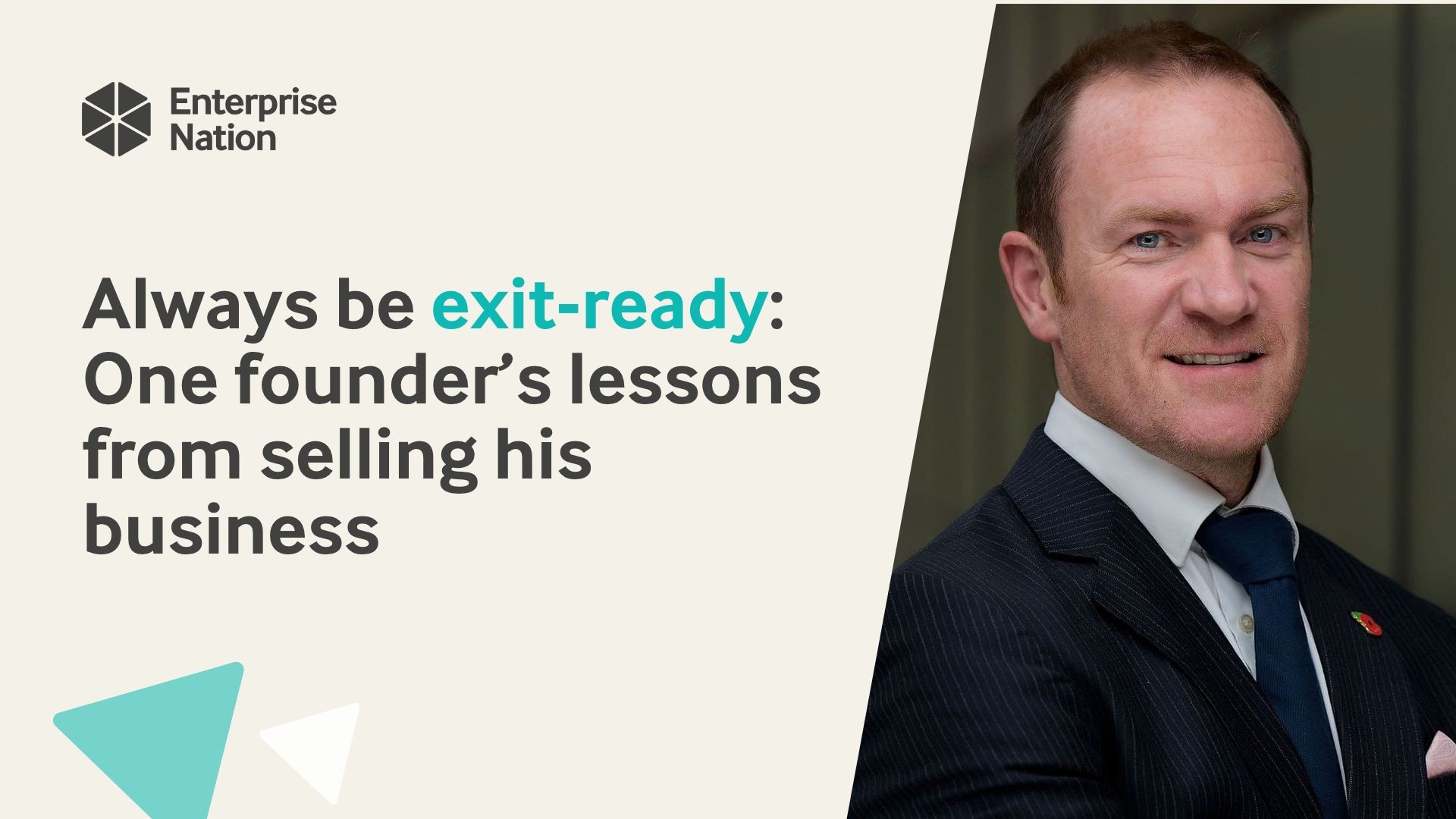
Always be exit-ready: One founder’s lessons from selling his business
Posted: Mon 9th Nov 2026
7 min read
Leigh Wells and his co-founders launched global data consultancy Comma Group in 2016 with the stated aim from inception of exiting the business after five years.
It sounds straightforward, but while the business went from strength to strength over the longer term, there were moments when it looked like the exit timeline was going to need to be stretched.
Leigh said that he still remembers the moment he realised his American expansion was on a rocky road.
It was 2019, and he was mid-flight across the Atlantic when his second-in-command sent his resignation. Three months earlier, the senior hire Leigh had brought in to run the US operation had quit without warning after 18 months. The business he had methodically built now faced redundancies, a co-founder buyout, and an uncertain future.
He recalled from his farmhouse in rural Warwickshire:
"There was a decision to make.
"Neither of us was moving to America. We closed it."
What followed was a two-year recovery that would culminate in precisely the outcome Leigh had planned from the start: a trade sale, five years after launch, to a US firm.
That journey, from launch in 2016 to a March 2021 acquisition by Amplifi, is now the blueprint for The Founders Exit, a platform Leigh has built to give other business owners what he wished someone had handed him in 2019.
The associate model
The idea for Comma Group came from Leigh's executive MBA at Warwick Business School, where he wrote his dissertation on whether a consultancy could scale using an associate model rather than hiring consultants permanently.
It was 2015, and the gig economy was reshaping how businesses thought about the workforce. Uber and Airbnb were rewriting the rulebook.
He said:
"I handed my dissertation in on the Friday and started the business on the Monday."
By March 2016, Leigh and two co-founders had launched Comma Group as a data consultancy.
While they did hire permanent staff for legitimacy and stability, the business was built to scale delivery through a network of associates. The strategy let them punch above their weight.
When Howdens Joinery needed to extract catalogue data and move it online, Comma could field business consultants, workflow designers and technical specialists without carrying the full overhead.
Hospitality group Whitbread became their first client. The model worked because Comma partnered with enterprise software vendors, becoming their preferred implementation partner.
"We just made sure we were at the top of that call list every time," Leigh explained. "We didn't have millions to spend on marketing. We were just the best at what we did."
Within five years, the business had grown to 60 permanent staff, 20 affiliates, and clients including Starbucks and major DIY retailers across the UK and Northern Europe.
The American detour
The US expansion seemed logical. The same software partnerships that had opened doors in Europe operated globally. Through a contact, Comma won Starbucks as a client and began building a team in North America.
Eighteen months in, it collapsed.
"We got the wrong team, basically," Leigh said. "Everything we'd done had just worked, until this happened.”
The closure forced redundancies and pushed the business into a loss-making position. But it also clarified something Leigh hadn't fully articulated before: the need for an exit timeline.
He continued:
"We went in with a very short window, five to seven years. It wasn't about the number, although that was good.
"It was about the timeline and proving whether we could do it."
The deal
The relationship that eventually led to the sale came from the same US network.
A business Leigh had met during the American expansion, running a similar consultancy, called in 2020 as the world entered lockdown. The hospitality clients Comma served had furloughed everyone, but DIY retailers couldn't hire fast enough.
"Everyone was at home Googling hammers," Leigh said. "They needed their hammer at the top."
The conversation about a potential partnership took a year. By mid-December 2020, Comma signed heads of terms. The deal closed in March 2021.
"Whilst it was a year in talks, we signed heads of terms mid-December and the deal was done by mid-March," he said.
The speed came down to preparation. Because Comma had outsourced legal work to a top-tier firm from the start, every customer contract was documented, signed, and filed. When the acquirer asked for due diligence materials, Leigh's team was able to produce them immediately.
The earn-out was structured over two years, with 20% of the value contingent on performance. After the first year, the buyer changed the terms to non-contingent, allowing Leigh to focus on integration rather than hitting targets.
His number two took over day-to-day operations during the transaction. The buyer, 8,000 miles away, stayed out of the office.
"They created an M&A role for me, which meant I didn't have to go back to the day job," Leigh said.
After the earn-out period, his exit from the business he had started six years earlier was straightforward.
Always be exit-ready
Leigh spent time after the sale advising other founders through their own transactions at a corporate finance firm. The pattern repeated: businesses arrived at the negotiating table unprepared, their valuation diminished by gaps they didn't know existed.
"I didn't know the whole world of M&A existed," Leigh admitted.
"I took it to my lawyer and the lawyer said, 'You need a corporate finance person.' I'm like, 'What's that?'"
The Founders Exit is designed to solve that problem before it becomes expensive.
The platform offers two tiers: free education on the transaction process, and a paid preparation level at £245 per month that generates a valuation, builds an exit plan, and highlights gaps that will reduce value.
"Better, more educated founders make for better transactions, for everyone," Leigh argued.
"A business is only worth what it is worth without you in the room. You find that out at the worst possible moment."
The platform is not FCA-regulated and does not broker deals. Instead, it aims to make the eventual conversation with advisers shorter and better informed. Early users range from pre-revenue start-ups to businesses turning over £30 million, each finding value in different features.
"The pre-start-up people are using the plan to understand what they need to build," he said. "The higher-end users have accelerated so quickly they still haven't got the knowledge of an exit, but they've done the numbers."
Five principles for building to exit
Leigh distils his experience into five recommendations for founders:
Start with the end in mind. "Why wouldn't you run your business and always be exit-ready? It's about accepting that at some point, there's going to be an exit, healthfully or unhealthfully."
Always be prepared. "Having a really nice structure for where you keep all your important things, customer contracts signed, all the basics, makes a huge difference when you strike a deal."
Outsource everything you don't understand. Comma's decision to use a top-tier law firm from the start paid off twice: once when a major client refused to pay, and the firm's letterhead got immediate attention, and again during due diligence when every contract was already filed and signed.
Understand your value drivers. "Know your customer and what value you're adding to maximise the value of your business. Most sellers know their buyers before the sale."
Organise relentlessly. "Someone asks for certain things, and you're like, 'It's in an email from about four years ago.' You're just not going to find it. You end up with all sorts at that point."
Leigh has recently added a sixth principle, still under development: is the founder ready to exit?
"I thought I was ready, but I don't think I'd put much thought into it," he reflected.
"There's a well-documented high percentage of people who fall straight into depression after the sale. The check's lovely, and then what do you do next? You lose your identity and purpose."
For now, Leigh is focused on testing The Founders Exit with businesses of all sizes, from street food vendors to £30 million revenue operations.
The platform that started as a solution to his own near-crisis is finding an audience among founders who, like him in 2016, are building something they know will one day need to change hands.
"You could be more prepared," he suggested. "And it's never the right time, but there are better times than others."
I am head of media at Enterprise Nation and have spent the past 12 years working with start-up and small businesses to help them build solid marketing and PR campaign strategies that really help them to grow. I have also worked with the national enterprise campaign StartUp Britain, the fintech investment platform provider Smart Pension and trade skills charity the HomeServe Foundation on media and policy. All of these were built from scratch and grew, with marketing and PR central to that expansion.